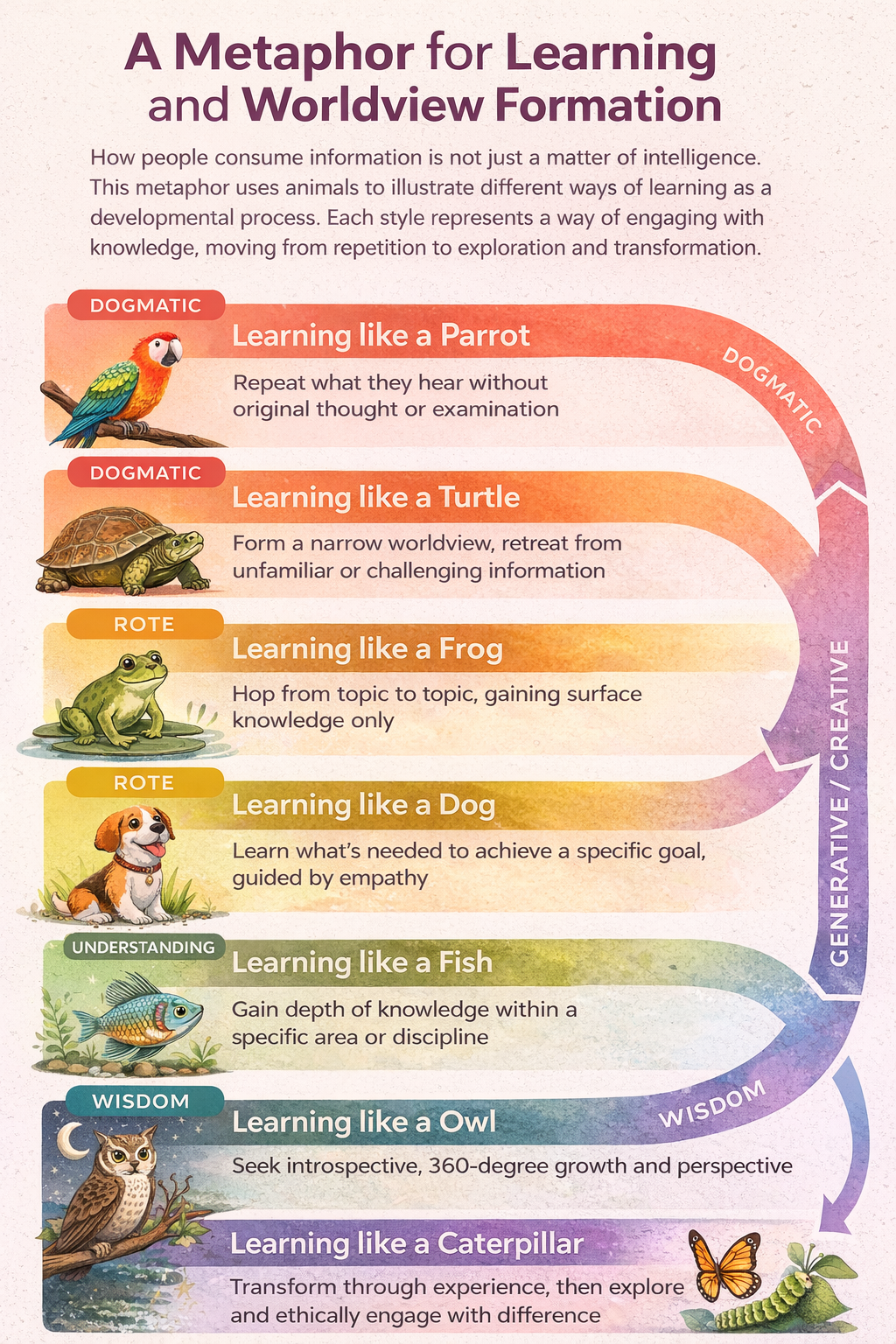
A Metaphor for Learning and Worldview Formation
How people consume information is not just a matter of intelligence or access—it is shaped by how they learn, reflect, and relate to difference. Learning styles quietly influence how worldviews form, how beliefs harden or evolve, and how individuals respond to uncertainty, complexity, and “the other.” This metaphor uses animals to illustrate learning as a developmental process rather than a hierarchy of intelligence. Each learning style represents a way of engaging with information, experience, and meaning—some rooted in repetition, others in depth, reflection, or transformation. These styles are not fixed identities; people may move between them across contexts or over time. The progression reflects an evolution from inherited belief and surface knowledge toward understanding, wisdom, and ethical engagement with difference. By framing learning this way, the metaphor remains broadly applicable—to climate literacy, media consumption, civic reasoning, education, and cultural dialogue—while emphasizing that growth is possible without erasing difference. In this model, learning is not about becoming “right,” but about expanding the capacity to see, reflect, and relate responsibly within an increasingly complex world.
A Metaphor for Learning, Information Consumption, and Worldview Formation
Learning like a Parrot (Dogmatic) Parrot learners do not develop original thoughts or opinions. They repeat what they hear, often verbatim, without examining meaning, context, or evidence. Their worldview is inherited rather than formed.
Learning like a Turtle (Dogmatic) Turtle learners form their worldview from a single point of view, creating a narrow cause-and-effect understanding that only recognizes what is directly in front of them. When confronted with unfamiliar information or ideas that challenge their assumptions, turtles retreat. This makes them especially susceptible to prejudice and bigotry embedded in political rhetoric, news narratives, and religious dogma.
Learning like a Frog (Rote) Frog learners hop from topic to topic like lily pads. They accumulate surface-level knowledge across many subjects but rarely dive beneath the surface. Their worldview is often shaped by headlines, social media posts, and short-form content, making them vulnerable to misinformation and disinformation.
Learning like a Dog (Rote) Dog learners display curiosity and exploration, but their learning is largely functional and goal-oriented. They learn what they need to learn to achieve a specific outcome. Their worldview is shaped by emotional cues—especially empathy—and they are attuned to core emotional states. While adaptive and relational, their learning remains limited by immediate purpose.
Learning like a Fish (Understanding) Fish learners possess deep understanding within a specific topic or discipline. This depth opens a worldview others may not see without similar knowledge. However, fish are limited by the banks of the river—confined to their domain of expertise. Fish learners are often academic and rely heavily on science or formal knowledge systems to inform their worldview.
Learning like an Owl (Wisdom) Owls are still and introspective in the light of knowledge and become active in the dark of uncertainty. Owl learners begin with questions—especially who and why. They focus on personal growth and cultivate a worldview informed by a 360-degree perspective. Owls are more interested in what they do not know and often experience their own lives as a mystery worth exploring.
Learning like a Caterpillar (Alterity) Caterpillars begin with a small worldview, spending their days consuming leaves. They enter a chrysalis and emerge transformed as butterflies. Butterflies migrate thousands of miles and depend on planetary health for their survival. For caterpillar learners, books are like leaves—sources of nourishment—and lived experience is the mechanism of transformation. After transformation, butterfly learners explore cultures, respect difference, and develop an appreciation for the natural world. Their worldview is shaped by ethical engagement with otherness.
Why this works conceptually
- Dogma reflects rigidity and inherited belief
- Rote reflects accumulation without depth
- Understanding reflects disciplined depth
- Wisdom reflects introspection and perspective
- Alterity reflects ethical engagement with difference