13Jan

Empathy is a word we hear everywhere—praised in workplaces, taught in schools, and often described as a foundation of a healthy society. It is commonly treated as a timeless virtue and a straightforward human trait. But when we look more closely at where the concept comes from and how it actually functions, a more nuanced picture begins to emerge.The story of empathy is less simple than its popularity suggests. Its roots lie not in psychology but in art theory. Its mechanisms are embedded in our nervous system. And its expression is shaped—often invisibly—by bias, context, and experience. What follows are six research-informed findings about empathy, drawn from history, neuroscience, and psychology, that help clarify what empathy is, where it came from, and how it operates in everyday life.

1. Empathy Is a Relatively Modern Concept with Artistic Origins

One surprising finding about empathy is how recent the word itself is. The English term empathy entered the language around 1908 as a translation of the German word Einfühlung, meaning “in-feeling.” The idea was introduced decades earlier, in 1858, by philosopher Rudolf Lotze—not to explain human relationships, but to describe how people experience art.

Einfühlung referred to the act of projecting one’s own feelings into a painting, sculpture, or even an inanimate object. Later, psychologist Theodor Lipps expanded the concept to include how people understand one another’s inner experiences. Edward Bradford Titchener ultimately introduced empathy into English to capture this phenomenon.

This historical finding is revealing. Empathy was never about becoming another person or absorbing their emotions entirely. From its earliest use, it described understanding while maintaining distinction—a theme that becomes important when empathy is confused with sympathy.

“Not only do I see gravity and modesty and pride and courtesy and stateliness, but I feel or act them in the mind's muscles… a simple case of empathy.”
— Edward Bradford Titchener, 1909

2. Empathy Differs from Sympathy in How It Relates to Suffering

Another key finding is that empathy and sympathy, though often used interchangeably, describe different psychological processes. A common metaphor helps clarify the distinction. Imagine someone has fallen into a deep pit.

  • Pity remains above, observing from a distance and expressing concern without engagement.
  • Sympathy enters the pit to suffer alongside the person, sharing emotional distress.
  • Empathy stays at the edge, understands what being in the pit is like, and offers support without taking on the suffering as its own.

This finding highlights empathy as a form of “engaged detachment.” It allows for understanding another person’s experience from within their perspective while maintaining enough distance to remain effective and grounded.

“[Empathy is] consideration of another person’s feelings… without making his or her burden one’s own.”
— Alberta Szalita, Psychiatrist, 1976

3. Empathy Has a Measurable Neurological Basis

Research in neuroscience supports the finding that empathy is not merely a social convention or learned behavior, but a biological capacity. Human survival has long depended on cooperation, and the brain reflects this evolutionary history.

When people observe others performing actions or experiencing pain, similar neural networks activate in the observer’s brain. Studies have shown that watching someone’s hand being pricked by a needle stimulates regions associated with pain perception. In other research, individuals showed activation in pain-related brain areas when they believed a loved one was experiencing discomfort.

This finding explains why empathic responses feel immediate and physical. At the same time, the brain dampens these responses, allowing people to register another’s experience without becoming overwhelmed—supporting connection without emotional overload.

4. Empathy Can Be Developed—and Can Also Decline

A common assumption is that empathy is a fixed personality trait. Research challenges this view. One important finding is that empathy functions more like a skill than an inherent quality. Studies in medical education, for example, have documented a decline in empathy during training. This decrease is associated with lower patient satisfaction, reduced trust, and poorer adherence to treatment recommendations. These findings suggest that empathy strengthens with intentional practice and weakens when ignored or suppressed. It is not lost because it was never there, but because the conditions needed to sustain it are absent.

5. Empathy Is Influenced by Bias and Group Boundaries

Another well-established finding is that empathy is not evenly distributed. People tend to experience stronger emotional resonance with those they perceive as similar or familiar. This pattern has evolutionary roots and is reinforced by social conditioning.

The brain’s threat detection systems can react to perceived differences almost instantaneously, sometimes before conscious reasoning occurs. As a result, empathic responses toward perceived “outsiders” may be reduced or blocked.

Research also points to a pathway beyond this limitation. Cognitive empathy—deliberate perspective-taking—can override automatic bias. Studies by social psychologist C. Daniel Batson indicate that intentionally valuing the well-being of others can generate genuine empathic concern, even across social or cultural divides.

6. Sustained Empathy Depends on Self-Empathy

A final finding is that empathy has limits. Emotional capacity is finite, and chronic stress or emotional overload reduces the ability to respond empathically. This pattern is especially evident in caregiving and service professions.

Self-empathy—the practice of extending understanding and care toward one’s own experience—plays a critical role in sustaining empathy over time. Rather than being self-centered, self-empathy supports resilience and prevents burnout, making it possible to continue offering care to others.

“Love and compassion are necessities, not luxuries. Without them humanity cannot survive.”
— The Dalai Lama

Conclusion: Applying These Findings in Practice

Taken together, these findings suggest that empathy is neither automatic nor limitless. It is a complex human capacity shaped by history, biology, learning, and context. It can be strengthened through intention, weakened through neglect, and misdirected by bias.

Understanding empathy in this way reframes it from a passive virtue into an active skill—one that benefits from awareness, practice, and care. Rather than asking whether we “have” empathy, these findings invite a more practical question: how are we choosing to use and sustain it?

References

Burton, N. (2024, June 24). The difference between empathy and sympathy. Psychology Today.

Empathy. (n.d.). In Online Etymology Dictionary.

Hardee, J. T. (2003). An overview of empathy. The Permanente Journal7(4), 51–54.

Riess, H. (2017). The science of empathy. Journal of Patient Experience4(2), 74–77. https://doi.org/10.1177/2374373517699267

10Jan

Introduction: The Hidden Blueprint of Power 

Why do some workplaces, political movements, or social groups become tense, unhealthy, or even harmful, while others encourage people to grow? This question has shaped much of my personal and professional observation. Over time, I’ve noticed that the answer often isn’t as simple as identifying “good leaders” and “bad leaders.” Instead, leadership tends to unfold along a predictable spectrum that can be seen in nearly every environment—corporate, civic, religious, or social. 

This article explores those patterns by examining leadership styles, cultural narratives, communication habits, and subtle indicators of dehumanization, we can begin to understand why groups become unhealthy and what supports healthier, more empowering environments. 

My goal is to offer a framework based on experience, research, and the perspectives of psychology, social science, and organizational theory.
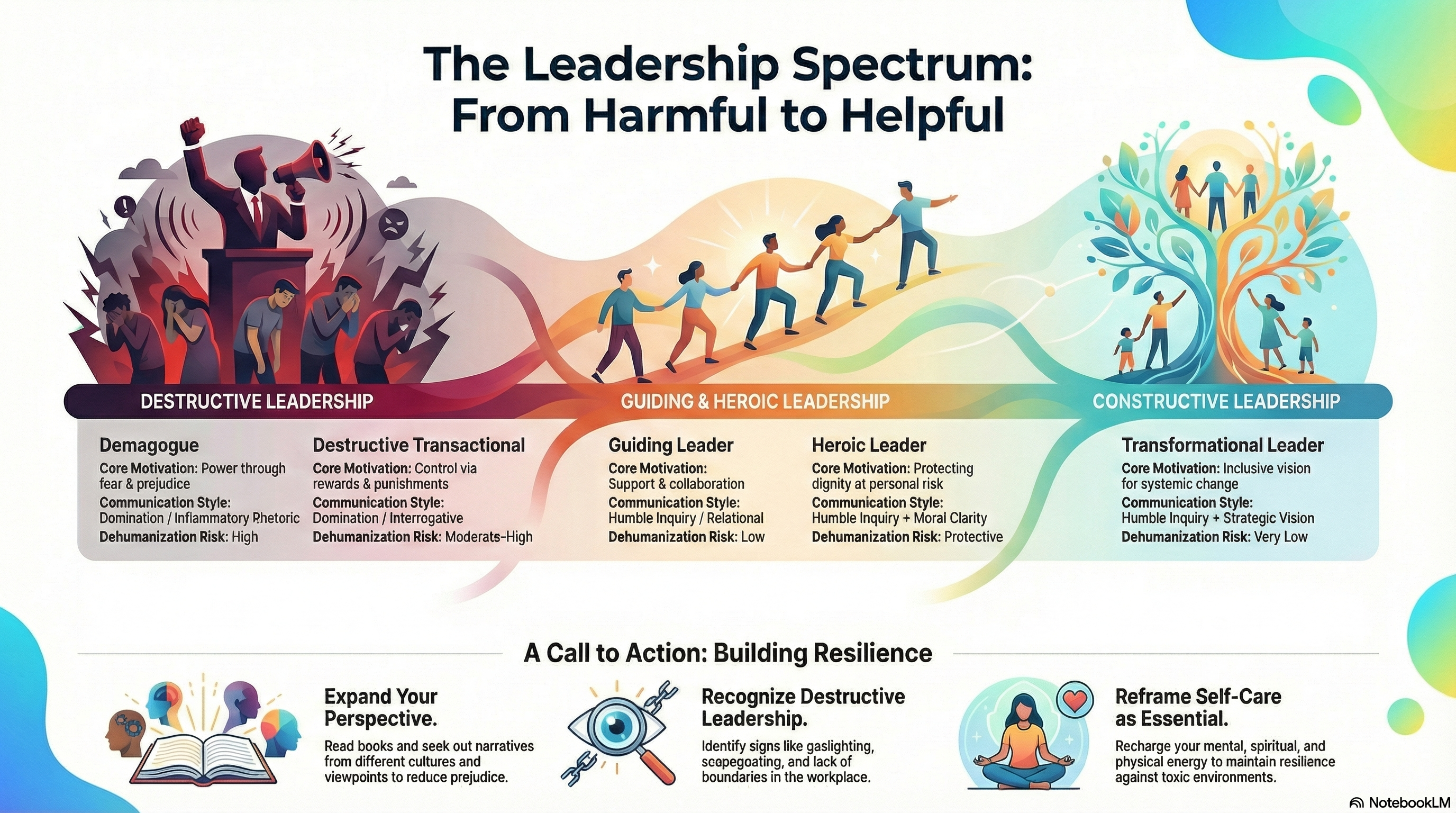
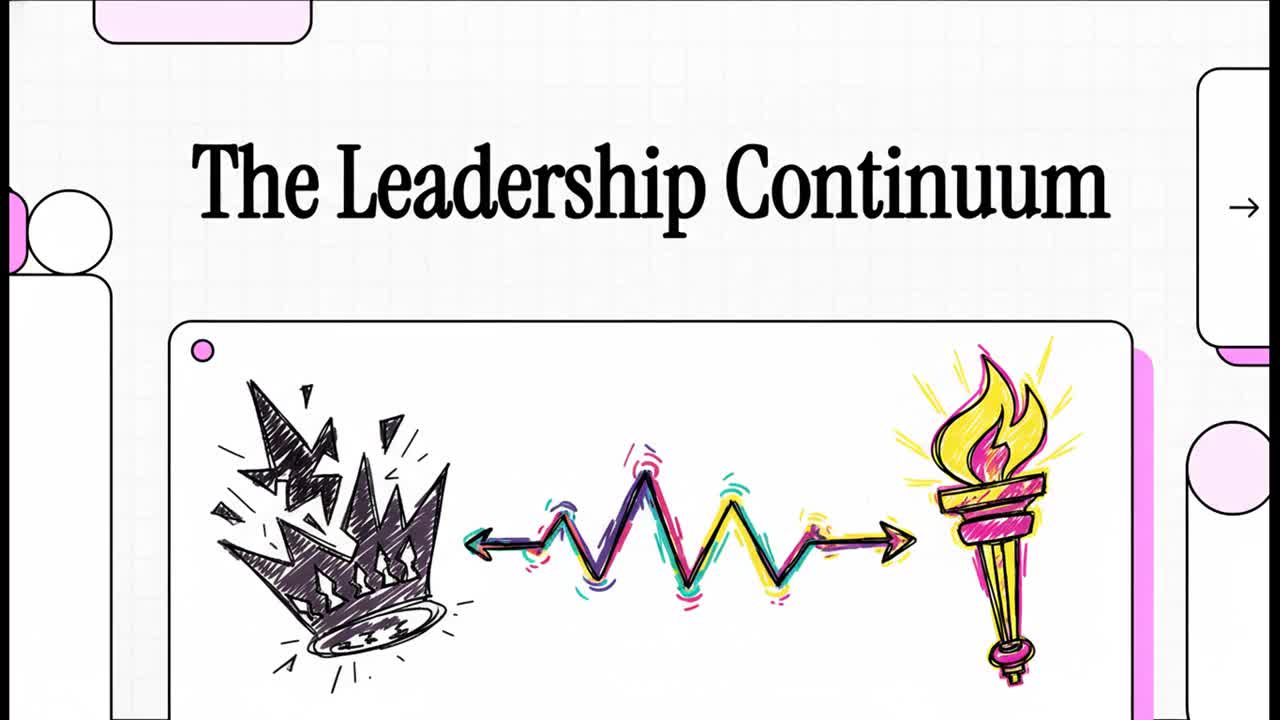
Takeaway 1: Leadership Isn’t a Title—It’s a Spectrum One of the most useful observations is that leadership is not a fixed trait or job description. Instead, it exists on a continuum of behaviors ranging from destructive to deeply empowering. This spectrum can help make sense of the wide variety of leadership styles we encounter, especially when titles alone do not reflect actual behavior. A practical version of this continuum includes six archetypes: 

  • Demagogic Leader
  • Manipulative Transactional Leader
  • Neutral/Conventional Transactional Leader
  • Guiding Leader
  • Hero (Interpersonal Moral Courage)
  • Transformational Leader

Each reflects a different way of influencing others. The demagogue uses fear, identity, and manipulation. Transactional leadership relies on authority, rules, and incentives. Guiding leadership emphasizes support and connection. Heroic leadership shows interpersonal moral courage. Transformational leadership inspires collective change through a shared vision. 

When viewed as a progression, the spectrum shows how influence evolves—from coercive forms of power to more relational and value-driven forms.

Takeaway 2: Workplaces Can Exhibit “Cult-Like” Dynamics While the word cult is often associated with extreme religious or political groups, the underlying dynamics—control, pressure, and isolation—can appear in more ordinary settings, including workplaces. This observation isn’t meant to sensationalize but to highlight common behavioral patterns that can be measured and recognized. Some key indicators include: 

  • Information Control – A single dominant narrative that cannot be questioned
  • Conformity Pressure – Subtle or overt pressure to avoid disagreement
  • Insularity – “Us vs. them” framing that isolates members from outside perspectives

These tendencies can emerge under many leadership styles, but they often correlate with leaders who rely heavily on authority, fear, or rigid control. Conversely, leaders who encourage questioning, openness, and shared accountability reduce these patterns. This framework is helpful because it focuses on observable behaviors rather than labels or intentions.
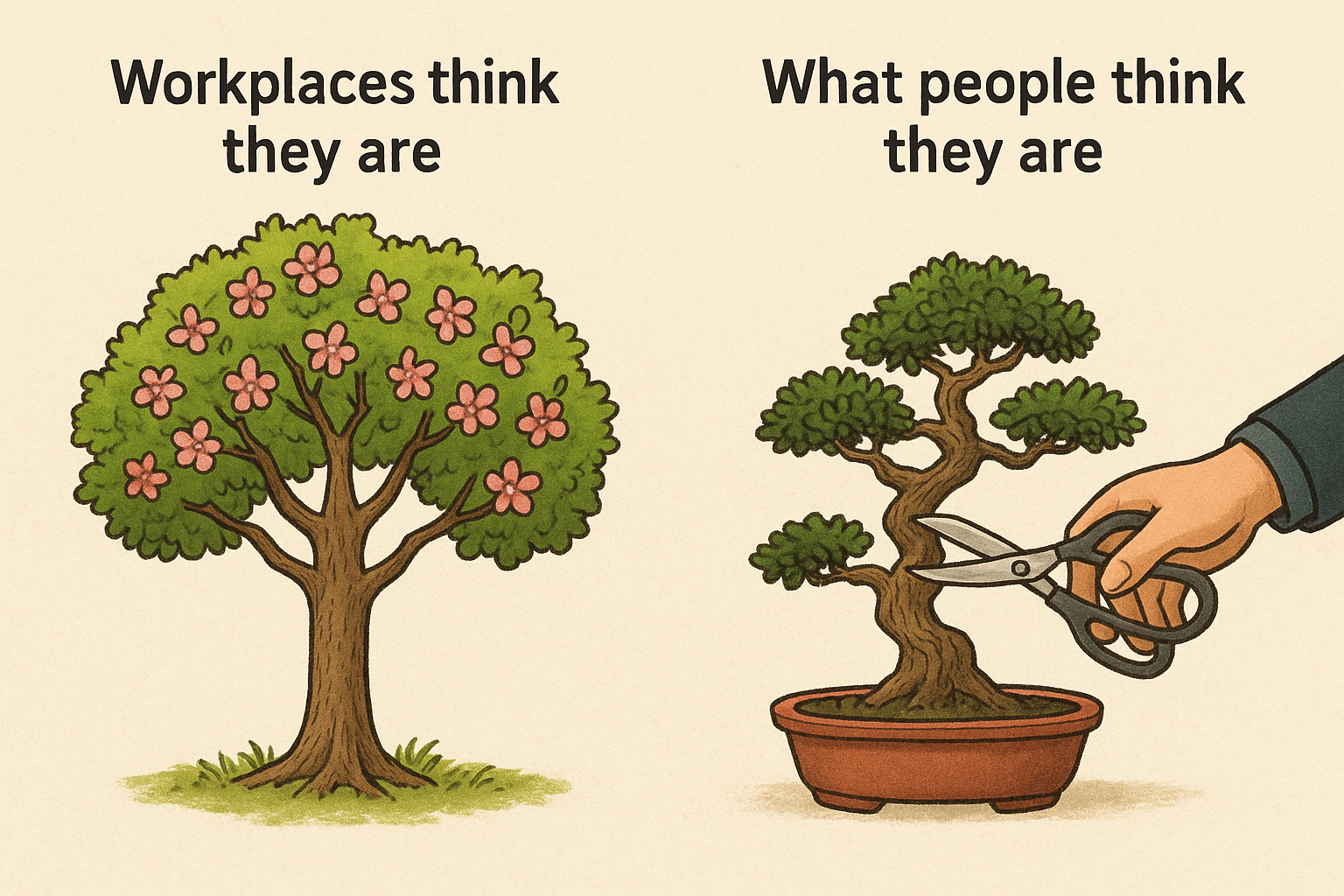
Takeaway 3: Dehumanization Is a Slow Progression, Not a Single Act 

Destructive behavior rarely begins with overt harm. Instead, it moves gradually through a series of small steps. This progression is well-documented in psychology, including Philip Zimbardo’s insights from The Lucifer Effect. The Stanford Prison Experiment demonstrated how quickly dehumanization can escalate once individuals are reduced to roles, labels, or numbers. Three meaningful stages include: 

  1. Objectification – Seeing people as “resources,” “problems,” or “units”
  2. Psychological Violence – Gaslighting, shaming, intimidation, or humiliation
  3. Ideological Dehumanization – Framing a group as inferior or dangerous

Even minor ethical lapses contribute to this progression. When disrespect becomes normalized, empathy erodes, and harmful behavior becomes easier to justify. Recognizing the early stages creates opportunities for prevention long before an environment becomes overtly toxic.

Takeaway 4: Rethinking the “Hero” as a Protector of Dignity 

The term “hero” is often reserved for large-scale transformation or extraordinary acts. In this framework, however, heroism is far more personal and accessible. A hero is someone who protects another person’s dignity even when there is social risk. This definition emphasizes: 

  • Small actions over grand gestures
  • Individual protection rather than system change
  • Moral courage instead of authority or status

Examples include speaking up against harmful language, supporting someone who has been dismissed or gaslit, or offering solidarity to a person who is being excluded. This reframes heroism as something anyone can practice, regardless of role or title.

Takeaway 5: Communication Style Reveals Inner Leadership Beliefs Communication isn’t just a technique—it reflects underlying beliefs about power, hierarchy, and dignity. Drawing on Edgar Schein’s work, communication can be viewed along a spectrum: 

Communication StyleAssociated Leadership Type
Domination / CommandingDestructive / Transactional
Humble Inquiry / IntimacyGuiding / Heroic / Transformational


As communication shifts from commanding (“telling”) to inquiring (“asking to understand”), the leader’s ego decreases and space for dignity increases. This shift supports psychological safety and healthier group dynamics. It also aligns closely with leadership models that emphasize humility, curiosity, and shared agency.

Conclusion: Understanding to Action 

The patterns described here—leadership types, cultural narratives, communication styles, and the progression of dehumanization—are not abstract theories. They are observable, repeatable, and relevant to everyday experiences in workplaces, families, communities, and political environments. 

Understanding these patterns allows us to recognize early warning signs and choose more constructive responses. It also helps us appreciate where healthier leadership already exists and how it can be strengthened. 

If there is a final takeaway, it may be this: meaningful change often begins with small acts. A single moment of moral courage, a shift toward dignified communication, or a decision to ask questions rather than make assumptions can interrupt harmful patterns before they escalate. 

What is one small, dignifying act you can take this week to support a healthier environment around you?

05Jan

Technology has become deeply embedded in everyday life, shaping how people communicate, work, manage finances, and access information. Along with its benefits, this reliance brings new challenges—particularly around security, digital literacy, and well-being. Drawing on insights shared by a computer technician, this article explores common technology issues, best practices for staying safe, and broader social impacts of our increasingly digital world.

Everyday Technology Problems: Scams Over Broken Screens 

Contrary to what many people expect, the most common technology problems are not cracked screens or failing hardware, but scams and malware. A significant portion of technical repair work today involves cleaning up compromised systems rather than fixing physical damage. 

One of the most prevalent threats is the familiar “Microsoft” or “Windows Defender” pop-up warning users that their computer is infected and instructing them to call a phone number immediately. These scams rely heavily on fear and urgency. Once contact is made, scammers often present themselves as legitimate technical support, using convincing language and technical jargon to build trust. Their primary goal is to gain remote access to a user’s computer. To do this, they may display normal system tools—such as system logs—to create the illusion of serious problems. Users are then pressured to install software, grant remote control, and ultimately pay for unnecessary or entirely fake services, often costing hundreds of dollars. 

Another growing issue involves deceptive online advertisements, particularly on social media platforms like Facebook. Some ads are designed to resemble legitimate notifications, such as Messenger alerts, and are placed strategically on the screen to encourage accidental clicks. These can lead users into similar scam scenarios. For those affected, the consequences can be disruptive and stressful, sometimes requiring bank accounts to be closed and professional assistance to remove malware and secure personal information.

Cybersecurity Basics: Awareness Over Complexity 

When it comes to cybersecurity, user awareness remains one of the most effective defenses. For most people, the greatest risk is not advanced hackers targeting them personally, but everyday mistakes—clicking on deceptive links or responding to alarming messages without verification. 

Data breaches are another persistent concern. Personal information is frequently leaked due to compromised business systems, yet accountability is often minimal. Companies may offer limited credit monitoring services, even when the long-term risks to individuals are significant. There are also concerns about third-party access to sensitive data. Call center employees, sometimes with minimal training, may have access to extensive financial and personal information, increasing the risk of misuse or accidental exposure. 

In terms of protection, antivirus software plays an important role. Malwarebytes is frequently recommended for its effectiveness, lightweight performance, and ability to detect hidden or unwanted programs. In contrast, some widely known antivirus products are criticized for slowing down systems, aggressive marketing practices, and questionable data-handling policies. Built-in tools like Microsoft Defender can be sufficient for more experienced users, but may not catch all threats, especially those already operating within a system.

Digital Well-Being and the Human Cost of Constant Connectivity 

Beyond security, technology has a profound impact on mental health and social behavior. For many people, especially smartphone users, their device has become a central hub for work, relationships, finances, and entertainment. This level of dependence can lead to heightened anxiety, even over minor technical issues, and the idea of being without a phone for a day can feel overwhelming. 

There are also broader social consequences. Constant online engagement - particularly through social media - has been associated with a decline in face-to-face conversation skills. Younger generations, in particular, may spend more time interacting online than in person, altering how relationships are formed and maintained. The rise of content creators and live streaming has contributed to parasocial relationships, where audiences feel personally connected to online personalities they do not actually know. This can blur the line between real and virtual relationships, sometimes reinforcing isolation rather than reducing it. 

Social media platforms themselves often amplify negative content. Algorithms tend to prioritize emotionally charged material, which can keep users in a prolonged state of stress or “fight or flight.” For some, disengaging from certain platforms becomes a necessary step toward protecting mental well-being. 

Customer service experiences add another layer of frustration. Outsourced call centers, automated phone systems, and complex menus often leave users feeling unheard. While these systems are designed to reduce costs, they can inadvertently shift customer frustration onto frontline workers who have little control over the underlying issues. A recurring reminder is the importance of directing frustration toward systems and decisions, not individuals.

Passwords, Misinformation, and Everyday Digital Literacy 

Managing passwords remains a persistent challenge. While digital password managers offer convenience, they can also be attractive targets for hackers. One surprisingly effective alternative is writing passwords down and storing them securely offline, which eliminates the risk of online database breaches. Many people cope with complex password requirements by reusing patterns across accounts, making small changes to meet different rules. While common, this practice still carries risks and can lead to forgotten credentials. 

Digital literacy also includes navigating misinformation. Social media is widely viewed as a poor source for accurate, real-time news. Verifying claims through multiple reputable sources remains essential, especially as AI-generated content becomes more convincing. Synthetic voices, images, and videos can now imitate real people, making it increasingly important to look for corroborating evidence rather than trusting a single source.

Artificial Intelligence: A Tool, Not a Substitute 

Artificial intelligence is still in an early stage of widespread adoption, but its potential is significant. Used thoughtfully, it can help compile information, simplify complex topics, and support creative processes. Rather than replacing human effort, AI can act as a catalyst—helping users brainstorm ideas, overcome writer’s block, or explore new perspectives. 

The quality of AI output depends heavily on how questions or prompts are written, which can, in turn, help users develop clearer communication skills. The value often lies as much in the process of refining inputs as in the results produced. At the same time, moderation is important. Like other digital tools, excessive use can lead to unproductive consumption patterns, reinforcing the broader principle that balance matters.

Community Needs and Emerging Trends 

A notable gap exists in digital literacy, particularly among retirees and others whose careers no longer require regular computer use. Skills that go unused tend to fade, leaving some people more vulnerable to scams and technical problems. Even younger generations can face challenges if their work and education rely primarily on mobile devices rather than traditional computers. There is also a growing trend toward device consolidation. Many users are replacing laptops with tablets or relying entirely on smartphones for email, payments, and entertainment. For younger users, handheld gaming systems combined with phones often eliminate the need for a desktop or laptop altogether. 

On the infrastructure side, the expansion of fiber internet presents new opportunities. Faster speeds, competitive pricing, and simpler setup processes are increasingly appealing alternatives to long-established providers, signaling gradual shifts in how communities’ access and use digital services.

Closing Thoughts 

Technology continues to reshape daily life in ways that are both subtle and profound. While new tools and platforms offer convenience and creativity, they also introduce risks that require awareness, adaptability, and ongoing learning. By focusing on practical security habits, maintaining digital balance, and strengthening community-level digital literacy, individuals can navigate the digital landscape with greater confidence and resilience.

03Jan

State of Planetary Climate Health

The Global Climate at a Glance 

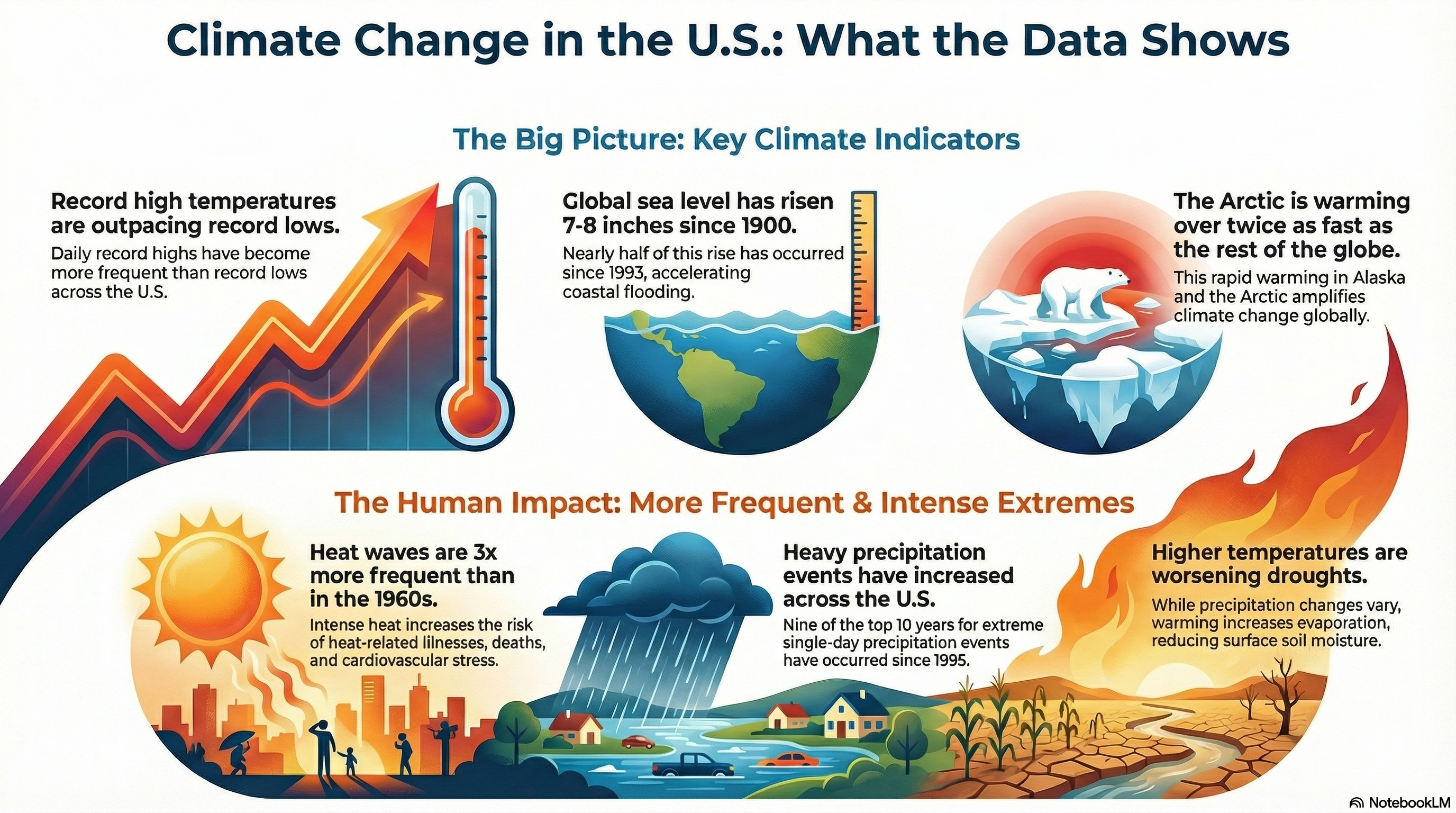
Human activities have pushed greenhouse gas concentrations, especially carbon dioxide, to levels not seen for several million years, committing the planet to long‑lasting warming, sea‑level rise, and ecosystem stress. Global average temperatures have already risen more than 1 °C above pre‑industrial levels, and the world is experiencing more frequent and intense heat waves, heavy rainfall events, droughts, and wildfires as a result. 

Despite growth in renewable energy and stronger climate policies in many countries, global emissions remain high, and the remaining “carbon budget” compatible with limiting warming to safer levels is now very small, meaning rapid and sustained cuts in emissions are needed to avoid more severe impacts.

Big Emitters and the Political Landscape 

China, the United States, and India are currently the three largest greenhouse gas emitters, together accounting for a very large share of global annual emissions, although their per‑person emissions and historical responsibilities differ substantially. All three participate in international climate processes and have announced emissions‑reduction targets and clean‑energy goals, but their policies and political debates often fall short of what scientific assessments indicate is needed to meet agreed temperature limits. 

International climate diplomacy is under strain: negotiations frequently stall over who should cut emissions fastest, how much financial support richer countries should provide, and how to reflect equity and development needs in long‑term pathways. This tension plays out in the language of global stock takes, finance decisions, and technology‑transfer discussions, and it heavily shapes whether global climate goals can be met.

Tension Around Climate Science 

Climate science itself is broadly accepted within the global process, but there is growing debate about how science is produced, interpreted, and used in negotiations. Many low‑ and middle‑income countries argue that scientific assessments and scenarios do not always capture their development priorities, local realities, or perspectives on fairness, and that this imbalance can influence which policies are treated as “scientifically necessary.” 

As a result, resistance to certain scientific references in negotiation texts is often less about denying physical facts and more about contesting whose knowledge counts and how responsibility is framed. This is turning the treatment of science into a political battleground over climate justice and historical responsibility, not just a technical matter of accuracy.

Changing Weather and Emerging Hazards 

Climate change is not only making extremes stronger; it is changing their patterns. Atmospheric rivers that bring a large share of rain and snow to places like the U.S. West are projected to become more frequent and, in many cases, more intense, raising the combined risks of both flooding and water‑supply disruption. In the United States, research shows that there are fewer days with tornadoes overall, but more tornadoes on those active days, which increases the likelihood of large, damaging outbreaks. 

Globally, evidence indicates that the regions where tropical cyclones reach their peak intensity have shifted toward higher latitudes, exposing communities that have less experience and infrastructure designed for such storms. Traditional notions of fixed “seasons” for hazards like wildfires are breaking down as hot, dry conditions and fuel build‑up lead to more frequent and severe fires outside historical windows, including in parts of Europe and North America.

Health, Safety, and Well‑Being in the United States 

Climate change is increasingly recognized in the United States as a public‑health and safety issue rather than just an environmental one. More frequent and severe heat waves raise risks of heat stroke, kidney stress, and cardiovascular problems, particularly for older adults, outdoor workers, and people without reliable cooling. Worsening air quality from wildfire smoke and ozone leads to more asthma attacks, lung irritation, and heart complications, and smoke from distant fires can now affect air quality across large parts of the country. 

Extreme rainfall, hurricanes, and river flooding threaten lives directly and can also disrupt hospitals, power, roads, and water systems, jeopardizing access to emergency care and clean water. These events, along with worries about future disasters, contribute to anxiety, depression, and other mental‑health challenges, especially in communities that experience repeated losses or displacement.

Minnesota: A Local Snapshot 

In Minnesota and the broader Upper Midwest, warming temperatures and ecological shifts are contributing to higher risks from ticks and mosquitoes and to more impactful weather events. Minnesota is consistently ranked as a high‑incidence Lyme disease state, with thousands of cases reported annually and a long tick season from late spring through early fall. Warmer conditions and changing habitats support the expansion and longer activity period of blacklegged ticks, which can increase exposure to Lyme and other tick‑borne illnesses. 

The state also faces recurring West Nile virus risk, with human cases most summers as mosquitoes benefit from warm, wet conditions and standing water. Heavier downpours and more frequent very‑wet days raise flood risk and can damage homes, roads, and health facilities, while smoke from large fires in Canada or the western U.S. periodically degrades air quality, triggering respiratory problems even when no fires burn locally. These combined pressures affect not only physical health but also day‑to‑day well‑being, as time outdoors, sense of safety, and economic security are increasingly shaped by climate‑related hazards.

Planetary Health and Human Well‑Being 

Taken together, these patterns show that planetary climate health and human well‑being are tightly linked. A hotter, more unstable climate is altering water, food, and disease systems, stressing infrastructure, and amplifying inequalities, while also challenging mental health as communities cope with uncertainty and repeated shocks. 

At the same time, many of the actions needed to restore climate stability—cleaner air, safer housing, greener cities, resilient health systems, and fairer economic arrangements—can directly improve health, safety, and quality of life if pursued ambitiously and equitably. In that sense, the state of planetary climate health is not only a warning but also a roadmap for protecting and enhancing well‑being in places like the United States and Minnesota, as well as globally.

Example Text

Example Text

References American Public Health Association. (2025). Health threats surge as scientists warn of edging toward irreversible climate change impacts. https://www.apha.org/ 

Centers for Disease Control and Prevention. (2025). Lyme disease case maps. U.S. Department of Health and Human Services. https://www.cdc.gov/lyme/data-research/facts-stats/lyme-disease-case-map.html 

Commonwealth Fund. (2025). State scorecard on climate and health. https://www.commonwealthfund.org/ 

European Commission Joint Research Centre. (2025). GHG emissions of all world countries – 2025 report. Publications Office of the European Union. 

European Commission Joint Research Centre. (2025). Europe’s fire season is expanding: New JRC report shows. https://joint-research-centre.ec.europa.eu/ 

Grist. (2026, January 1). Wildfire smoke is a national crisis, and it’s worse than you think. https://grist.org/ 

Minnesota Department of Health. (2025). Lyme disease: Statistics and annual summary of reportable diseases. https://www.health.state.mn.us/ 

National Centers for Environmental Information. (2023). Billion-dollar weather and climate disasters. National Oceanic and Atmospheric Administration. https://www.ncei.noaa.gov/access/billions/ 

National Centers for Environmental Information. (2022). Weather-related fatality and injury statistics. National Oceanic and Atmospheric Administration. https://www.weather.gov/hazstat 

National Oceanic and Atmospheric Administration. (2023, January 9). 2022 U.S. billion-dollar weather and climate disasters in historical context. Climate.gov. 

Scripps Institution of Oceanography. (2016, August 11). How the world passed a carbon threshold and why it matters. University of California San Diego. 

United Nations Framework Convention on Climate Change. (2023). Nationally determined contributions under the Paris Agreement: Synthesis report. UNFCCC Secretariat. 

U.S. News & World Report. (2025, September 25). Climate change affects health: Here’s where. https://www.usnews.com/ 

World Resources Institute. (2023, February 2). This interactive chart shows changes in the world’s top 10 emitters. https://www.wri.org/

01Jan

Brain Health

Most of us don’t wake up thinking about our brains. We think about coffee. Deadlines. Kids. Traffic. The strange exhaustion that arrives before lunch. But quietly—without asking for attention—your brain is doing more work than any other organ in your body. Even though it makes up only about 2% of your weight, it burns roughly 20% of your daily energy. Every memory, mood shift, decision, and moment of focus draws from the fuel you give it. 

Your brain isn’t dramatic about this. It doesn’t announce when the fuel is wrong. It just gets a little foggier, a little more irritable, and little slower to recover from stress. Over time, those little signals add up. What you eat, especially how sugar shows up in your food, has a quiet but powerful influence on how clearly you think, how steady your mood feels, and how well you can focus. This story isn’t one of willpower or restriction. It’s fiber.

The Tale of Two Sugars

Your brain runs on glucose, a simple sugar. That part is unavoidable. The difference isn’t whether you eat sugar - it’s how that sugar arrives.

The Steady Kind

Think about biting into an apple. It’s sweet but it’s also crunchy, watery, and filling. That sweetness comes wrapped in fiber, vitamins, and water. Your body has to work to break it down, and that effort slows everything. The result? Glucose trickles into your bloodstream instead of flooding it. Your brain gets a steady supply of energy rather than a surge followed by a collapse. This is the kind of fuel that supports learning, memory, and emotional steadiness. This is just steady state when fueling the brain with fiber-rich sugar.

The Loud Kind

Now think about soda, candy, pastries, or many packaged breakfast foods. These contain added sugars - sugars stripped of fiber and context, designed to absorb quickly. When you eat them, glucose hits your bloodstream fast. Your brain responds with a brief chemical celebration—dopamine and serotonin spike, and for a moment you may feel energized, focused, or soothed. Then comes the drop. Your body scrambles to manage the sugar surge, blood glucose falls quickly, and the brain feels the consequences: fogginess, irritability, restlessness, anxiety, or fatigue. The reward system remembers the brief pleasure, though—and encourages you to repeat the cycle. Over time, a diet heavy in added sugars has been linked to inflammation in the brain and difficulties with learning and emotional regulation. The effects aren’t always dramatic—but they are cumulative. The good news is that there’s a built-in stabilizer that changes the entire equation.

Fiber: The Quiet Stabilizer

Fiber doesn’t get much attention because it doesn’t create a sensation. You don’t feel fiber working. But it may be one of the most important nutrients for your brain.  Fiber is a carbohydrate that your body can’t digest.  When fiber is present, sugar slows down. Absorption becomes gradual. Blood glucose rises gently instead of spiking. Your brain stays supplied without being overwhelmed. Protein helps with fullness. Fat helps with satisfaction. Fiber is uniquely effective at controlling how sugar affects your brain by reducing the metabolic stress that leads to inflammation and mental fatigue. In practical terms, fiber turns food into long-lasting mental energy.

The 5-to-1 Rule

Nutrition labels can feel overwhelming, so here’s a simple filter that works surprisingly well: 

For every 5 grams of sugar, look for at least 1 gram of fiber. 

This ratio mirrors how sugar shows up in nature. An apple, for example, has roughly a 5-to-1 sugar-to-fiber ratio. Foods closer to 2-to-1 or even 1-to-1 are even better. This one check can help you spot foods that support steady energy instead of quick spikes.

Connecting brain health to our state

Commercialism creates barriers to understanding the implications of the sugar, body, brain connection. Sugar and confectionary products industry is estimated to spend over $600 million on advertising, while beverage companies spend about $1 billion. These corporate narratives with a busy life can make it difficult to understand how much sugar people consume or how much we should consume. What is the recommended amount of sugar? Spotting Added Sugar The American Heart Association recommends keeping added sugar under: 

  • 25 grams (6 teaspoons) per day for women
  • 36 grams (9 teaspoons) per day for men

 For context: 

  • One 12-ounce soda contains about 42 grams of added sugar
  •  Many flavored yogurts contain 15–20 grams

Choosing Foods That Fuel Brain Health

Some foods come naturally packaged in a way your brain recognizes and appreciates. 

Fruits 

  • Blueberries support memory and learning through powerful antioxidants.
  • Apples offer fiber for steady energy and compounds that protect brain cells.
  • Bananas provide gradual glucose and vitamin B6, important for mood-regulating neurotransmitters.

 Vegetables 

  • Leafy greens like spinach and kale are associated with significantly slower cognitive aging.
  • Broccoli contains compounds that reduce inflammation and support brain detox pathways.
  • Carrots deliver antioxidants that help protect neurons over time.

None of these foods promise instant clarity but do offer reliability.

Nutritional Mindfulness

This isn’t about giving up the things we enjoy. It’s about developing a philosophy of enjoyment with awareness - understanding moderation, noticing how stress shapes our eating habits, and learning to read nutrition labels so we can cut through the noise of commercialized food messaging. Nutritional mindfulness invites us to slow down and reconnect cause and effect: how what we eat influences how we think, feel, and function. It’s not about restriction - it’s about attention. Considerations for finding balance while still enjoying sweetness: 

  • Savor sweet treats, intentionally and in moderation. Keep portions small, eat slowly, and allow enjoyment to come from presence rather than quantity.
  • Notice how you feel after meals. Energy, mood, focus, or fog. Journaling—even briefly—can help reveal patterns that otherwise go unnoticed.
  • Begin the day with nourishment in mind. Something as simple as a banana at breakfast can be an intentional act of fueling the brain before the day’s demands begin.
  • Track daily weigh-ins with curiosity, not judgment. Daily weigh-ins can help connect nutrition, stress, and weight changes—offering feedback rather than self-criticism.

References

At its core, nutritional mindfulness is about listening—using everyday choices as information. When we pay attention, food stops being just fuel or indulgence and becomes part of a larger conversation with our bodies and minds.

Alahmari, L. A. (2024). Dietary fiber influence on overall health, with an emphasis on CVD, diabetes, obesity, colon cancer, and inflammation. Frontiers in Nutrition, 11, 1510564. https://doi.org/10.3389/fnut.2024.1510564. 

American Heart Association. (n.d.). How much sugar is too much?

Centers for Disease Control and Prevention. (2024, July 16). Your brain and diabetes. 

Edwards, S. (2016). Sugar and the brain. On The Brain: The Harvard Mahoney Neuroscience Institute Letter, Spring 2016. Harvard Medical School. 

Gillespie, K. M., White, M. J., Kemps, E., Moore, H., Dymond, A., & Bartlett, S. E. (2024). The impact of free and added sugars on cognitive function: A systematic review and meta-analysis. Nutrients, 16(1), 75. https://doi.org/10.3390/nu16010075. 

Harvard T.H. Chan School of Public Health. (2025). Fiber. The Nutrition Source

Murray, S., Tulloch, A., Criscitelli, K., & Avena, N. M. (2016). Recent studies of the effects of sugars on brain systems involved in energy balance and reward: Relevance to low calorie sweeteners. Physiology & Behavior164(Pt B), 504–508. https://doi.org/10.1016/j.physbeh.2016.04.004

30Dec

An Analysis of Spirituality and Modern Life 

Joseph Campbell is best known for his work on ancient myths, but his real relevance today may be how clearly he saw the problems of modern life coming. Long before burnout, anxiety, and “purpose culture” became everyday topics, Campbell was asking a deeper question: What happens to people when the stories that once gave life meaning stop working?

Campbell believed that myths were never just old stories. In traditional societies, they functioned like a shared operating system. They explained how the world worked, what mattered, how to live a meaningful life, and how to face suffering and death. You didn’t have to invent meaning on your own—it was built into the culture, the rituals, and the rhythms of daily life.

Modern life, Campbell argued, quietly dismantled that shared framework.

Losing the Big Story

According to Campbell, modern societies didn’t just outgrow myth—they outpaced it. Science gave us extraordinary knowledge about how the universe works, but it didn’t replace the symbolic stories that helped people feel connected to life itself. At the same time, rapid technological change, global pluralism, and individualized identity made it impossible for any single shared myth to hold society together.

The result wasn’t freedom alone—it was fragmentation.

Myth didn’t disappear; it became personal. Each individual was suddenly responsible for figuring out who they are, what matters, and why life is worth living. That shift can be liberating, but it also leaves people unmoored. When there’s no shared symbolic grounding, people naturally look for substitutes. Political ideologies, conspiracy narratives, and extreme forms of nationalism often rush in to fill the gap. They offer identity, purpose, and a clear “us vs. them” story—but without the depth or humility of true myth.Campbell saw this not as a moral failure, but as a structural vulnerability.

Purpose vs. Being Alive

One of Campbell’s most challenging ideas is his skepticism toward the modern obsession with “finding your purpose.” He believed that chasing meaning as a goal often pulls people away from life rather than deeper into it.

We tend to treat meaning like a destination: Once I figure out my purpose, then life will make sense. Campbell thought this mindset turns life into a project instead of an experience. It keeps us mentally living in the future rather than fully present in the moment.

This is where his famous phrase “follow your bliss” is often misunderstood. He wasn’t talking about happiness, success, or self-indulgence. He was pointing to moments when the constant self-monitoring quiets down—when you’re so engaged that you forget yourself and feel fully alive. Bliss, for Campbell, was about participation, not achievement.

Seen alongside Viktor Frankl’s work, the contrast becomes clearer. Frankl showed how searching for meaning can help people survive unimaginable suffering. Campbell didn’t deny that—but he warned against turning meaning into something rigid or final. Meaning can support us, but when we cling to it too tightly, it can also become another trap. Sometimes the search itself is the point.


The Problem with a Goal-Driven Life

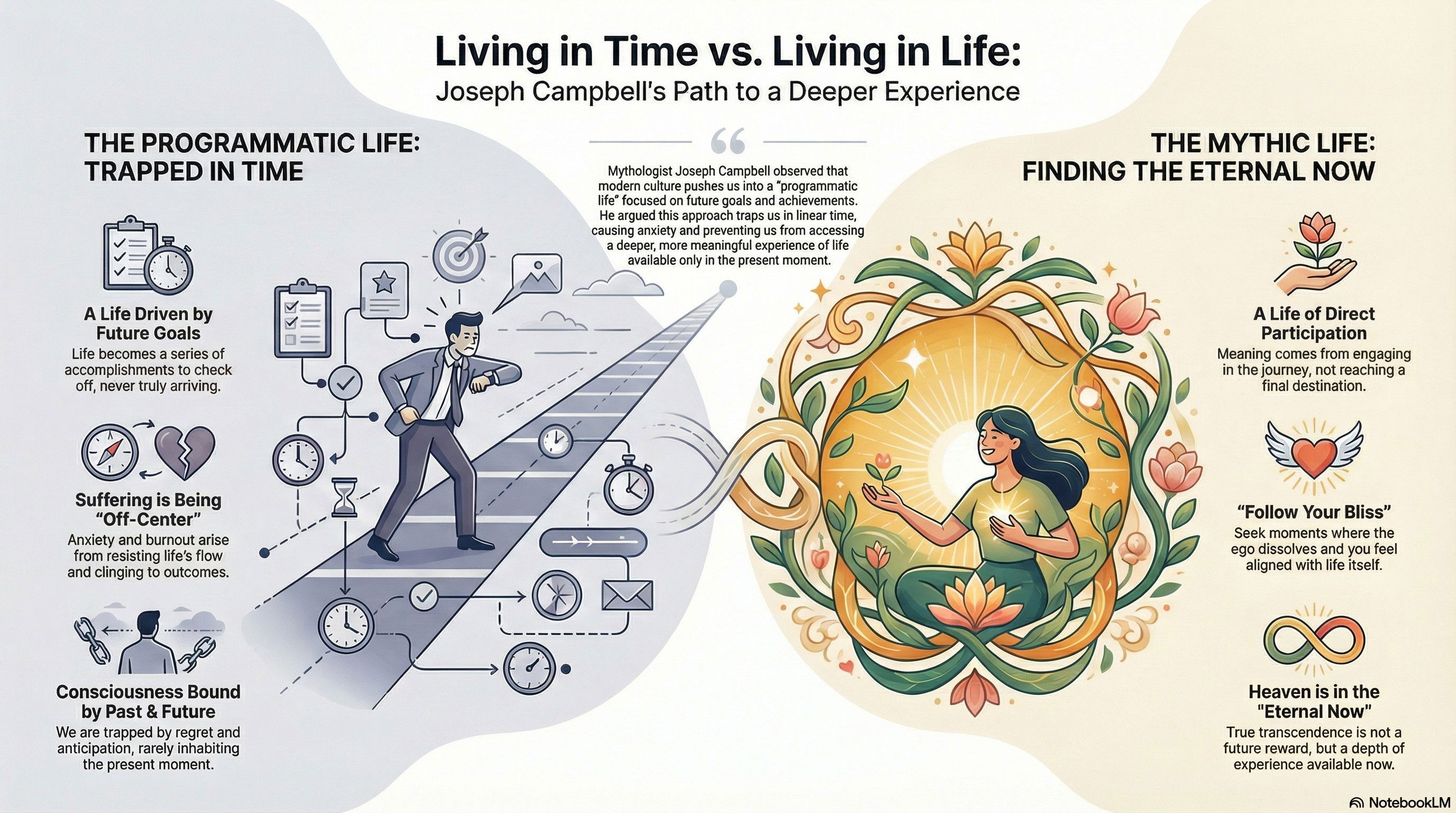
Campbell was deeply critical of what he called “programmatic living”—a way of life organized almost entirely around goals, milestones, and future rewards. Modern culture trains us to think in timelines: Once I finish this… once I get there… once I achieve that…

The problem is that “there” never really arrives.

Life becomes a constant cycle of accomplishment followed by the next target. Instead of rituals, we have résumés. Instead of presence, we have productivity. Even time itself gets treated like a resource to manage, save, or optimize.

Campbell contrasted this with what he called the “eternal now.” He didn’t mean eternity as endless time in the future, but depth in the present. When we stop obsessing over what’s next, there’s a different quality of experience available—one where life feels fuller, richer, and more real.

Rethinking Suffering

Campbell didn’t believe suffering could—or should—be eliminated. What he challenged was how much of our suffering is amplified by resistance. When we’re tightly attached to outcomes, identities, and expectations, life constantly feels like it’s going wrong.

He described this state as being “off-center.” From that perspective, suffering isn’t a failure—it’s feedback. It shows where we’re clinging instead of participating. Pain may be unavoidable, but much of modern stress comes from trying to control life rather than live it.

The Cost of Living on Hold

Campbell’s lasting insight is that many of today’s mental and emotional struggles aren’t personal shortcomings. They’re the predictable result of a culture that keeps deferring life itself. We’re always preparing, optimizing, improving—but rarely arriving.

What religions once symbolized as heaven, Campbell suggested, was never meant to be a reward at the end of life. It was a way of pointing to the depth of life when it’s fully lived.In a world obsessed with progress, his work offers a quiet but radical reminder: life doesn’t begin later. It only happens now.

29Dec

When most people think of Dante Alighieri’s The Divine Comedy, they picture a grim and terrifying tour of Hell. The poem’s first section, Inferno, with its nine concentric circles of torment, has so thoroughly captured the popular imagination that its imagery has become synonymous with damnation itself. We envision fire, brimstone, and grotesque punishments tailored to every imaginable sin. 

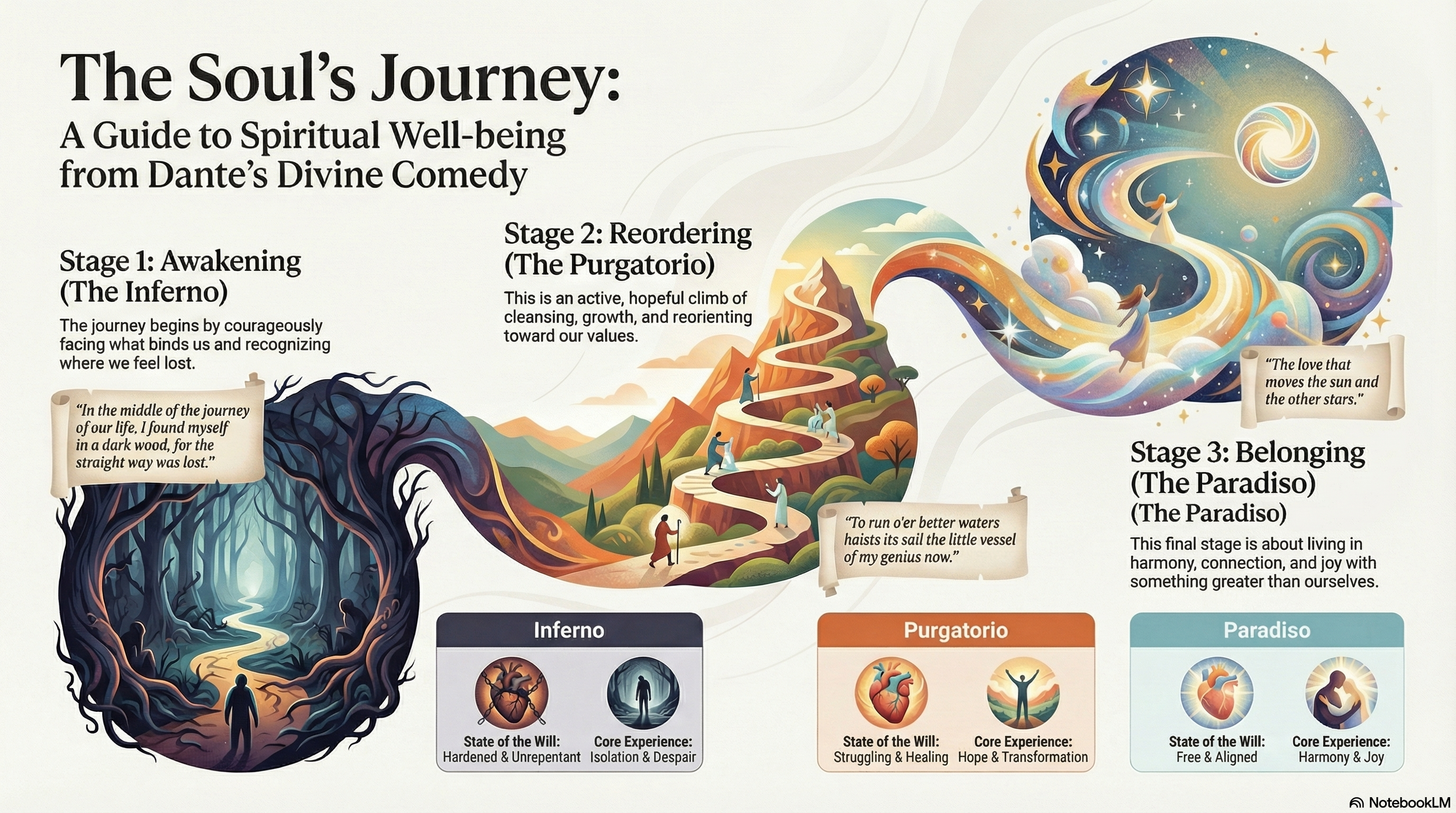
Yet, to focus on the infernal machinery is to mistake the entryway for the entire cathedral. The poem's true purpose, revealed by its very title, is not to map damnation, but to chart a course for spiritual recovery. In Dante’s time, a "comedy" was not a story meant to be funny, but one that began in despair and confusion and ended in joy and enlightenment. The poem is an epic of transformation, an allegorical map of the soul’s journey out of a "dark wood" of personal crisis and toward cosmic harmony.

This 700-year-old masterpiece is far more than a historical artifact. It is a timeless exploration of human nature, morality, and the search for meaning. Our purpose here is to excavate several counter-intuitive truths about human nature and the soul's orientation toward meaning hidden within its verses.

1. It’s a "Comedy," But Not Because It's Funny

In the classical world, literary genres had specific structural definitions. A tragedy was a narrative that began in a state of happiness or order and ended in sorrow, ruin, or death. In contrast, a comedy began in a state of difficulty, chaos, or confusion but concluded with a joyful and enlightened resolution.The Divine Comedy is the quintessential example of this comedic form. Its three parts map a clear upward trajectory:

Inferno (Hell) represents the state of despair and being lost.

Purgatorio (Purgatory) represents the difficult process of struggle, cleansing, and transformation.

Paradiso (Paradise) represents the achievement of joy, meaning, and union with the divine.

This reframing is philosophically powerful. It suggests that hardship and confusion are not the tragic end of a story but the necessary first act. For Dante, life’s journey is not defined by the fall from grace but by the arduous, hopeful climb toward resolution. This structure is more than a literary device; it's a theological argument that the universe itself is fundamentally comedic, bending not toward chaos, but toward justice, love, and ultimate reconciliation.

2. The Worst Sins Aren’t Violence or Lust—They’re Betrayal

Dante’s Hell is structured with a precise moral logic: the further one descends, the more severe the sin. The upper circles punish sins of "incontinence"—failures of self-control like lust, gluttony, and wrath. While serious, Dante considers these sins of passion to be less corrupting than sins of malice, which involve the deliberate use of reason to harm others. 

The deepest and most terrible part of Hell is the Ninth Circle, reserved not for murderers or heretics, but for traitors. Here, there is no fire; the punishment is to be frozen in a lake of ice. The symbolism is stark: those who denied the warmth of love and trust in life are eternally deprived of it in death. At the very center of the universe, Satan himself is encased in ice, chewing on the three greatest traitors in history: Judas Iscariot (who betrayed Christ) and Brutus and Cassius (who betrayed Julius Caesar). 

For Dante, this was not a theoretical sin; as a man betrayed and exiled from his beloved Florence, he understood that treason was a cold poison that dissolves the very foundations of society and self. The ultimate corruption of the human spirit is not a crime of passion but the cold, calculated decision to betray a sacred trust.

3. Damnation Isn't a Punishment, It's a Choice

A central tenet of Dante’s vision is the sanctity of free will. It is the divine gift that makes us human, allowing us to choose our path. This concept radically reshapes the idea of damnation. In Dante's Inferno, souls are not in Hell because God sent them there as retribution; they are there because they have chosen to be.

The will of the souls in Hell is described as "hardened" and "unrepentant." They are frozen in their chosen sins, eternally clinging to the pride, envy, or anger that defined them in life. Crucially, they no longer want to change. In contrast, the souls in Purgatory are defined by a will that is "struggling, wounded, but healing." They willingly undergo painful purification because their will is now oriented toward the good. This journey of the will culminates in Paradise, where the soul’s desires become so perfectly aligned with divine love that it achieves true freedom—not by losing its will, but by fulfilling it completely.

Damnation, therefore, is not an external sentence but the internal state of a soul that has permanently locked itself away from change.

"A soul that clings to its sin and rejects transformation."

4. Human Reason Can Only Take You So Far

For the first two-thirds of his journey, Dante is led by the Roman poet Virgil, a figure he deeply admires as his master and guide. In the poem's allegory, Virgil represents the pinnacle of human reason, wisdom, and classical virtue. It is reason that allows Dante to understand the nature of sin in the Inferno and the process of moral correction in the Purgatorio.

But Virgil's guidance has a limit. As a virtuous pagan who lived before Christ, he cannot enter Paradise. At the gates of Heaven, he must turn back, and a new guide appears: Beatrice. A woman Dante loved from afar in his youth, Beatrice is transfigured in the poem into a symbol of immense power.

This transition is one of the most significant moments in the work. It signifies that while human reason is essential for navigating the moral world and understanding our own failings, it is ultimately insufficient for achieving true spiritual fulfillment. To reach the highest state of joy and union with the divine, one must be guided by what Beatrice symbolizes: divine love, grace, and theological wisdom.

The Love That Moves the Stars

His final vision is not of judgment, but of a cosmic harmony that animates all of existence, resolving his journey with one of the most sublime lines ever written.

Ultimately, The Divine Comedy is far more than a medieval catalog of sins and virtues. It is a timeless map of the human condition, charting the universal movement from being lost in darkness toward finding purpose and light. Dante’s journey shows us that spiritual well-being is not the absence of hardship, but the presence of a sacred orientation—a soul aligned with its purpose.

"The Love that moves the sun and the other stars."

27Dec

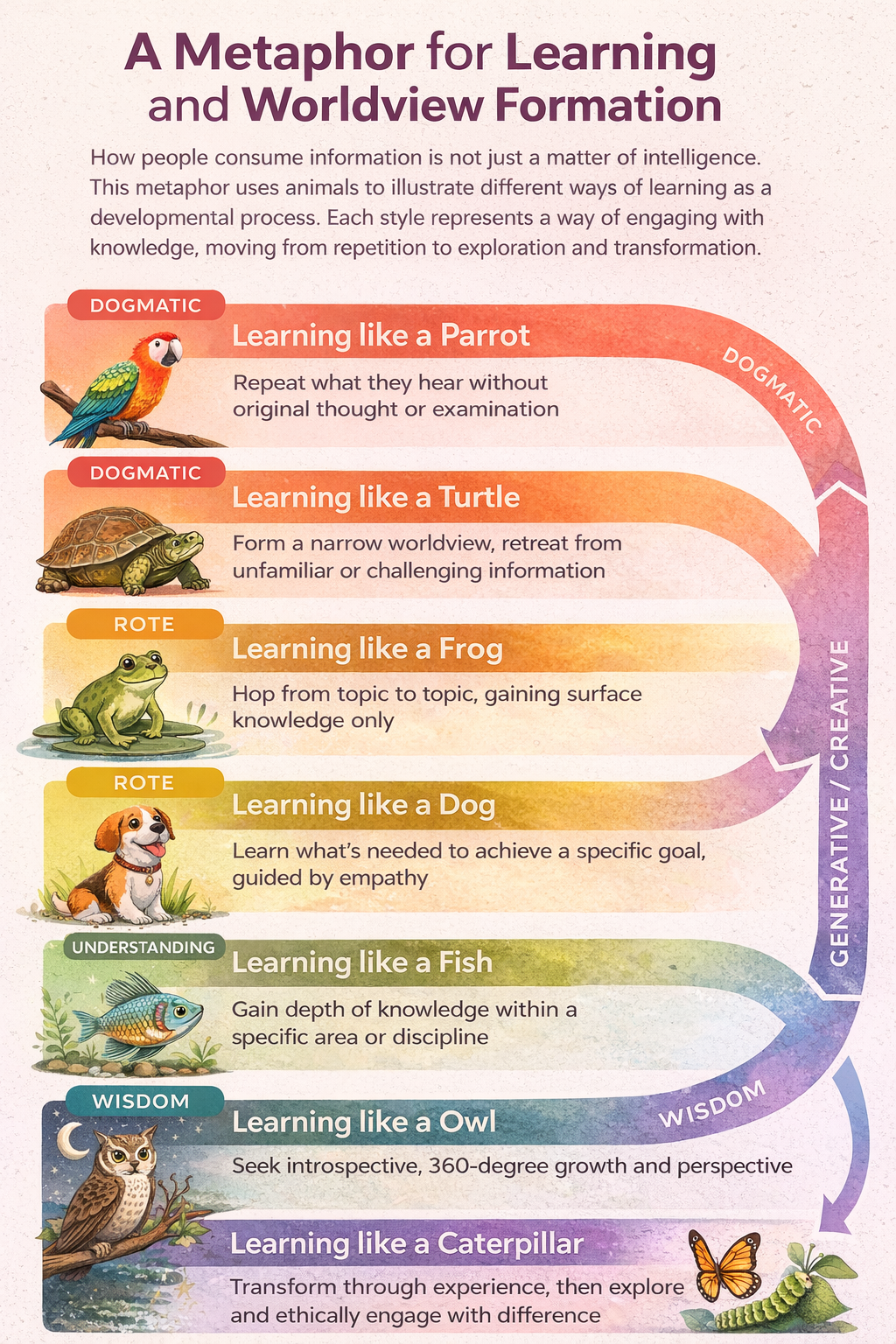
How people consume information is not just a matter of intelligence or access—it is shaped by how they learn, reflect, and relate to difference. Learning styles quietly influence how worldviews form, how beliefs harden or evolve, and how individuals respond to uncertainty, complexity, and “the other.” This metaphor uses animals to illustrate learning as a developmental process rather than a hierarchy of intelligence. Each learning style represents a way of engaging with information, experience, and meaning—some rooted in repetition, others in depth, reflection, or transformation. These styles are not fixed identities; people may move between them across contexts or over time. The progression reflects an evolution from inherited belief and surface knowledge toward understanding, wisdom, and ethical engagement with difference. By framing learning this way, the metaphor remains broadly applicable—to climate literacy, media consumption, civic reasoning, education, and cultural dialogue—while emphasizing that growth is possible without erasing difference. In this model, learning is not about becoming “right,” but about expanding the capacity to see, reflect, and relate responsibly within an increasingly complex world. 

A Metaphor for Learning, Information Consumption, and Worldview Formation

Learning like a Parrot (Dogmatic) Parrot learners do not develop original thoughts or opinions. They repeat what they hear, often verbatim, without examining meaning, context, or evidence. Their worldview is inherited rather than formed. 

Learning like a Turtle (Dogmatic) Turtle learners form their worldview from a single point of view, creating a narrow cause-and-effect understanding that only recognizes what is directly in front of them. When confronted with unfamiliar information or ideas that challenge their assumptions, turtles retreat. This makes them especially susceptible to prejudice and bigotry embedded in political rhetoric, news narratives, and religious dogma. 

Learning like a Frog (Rote) Frog learners hop from topic to topic like lily pads. They accumulate surface-level knowledge across many subjects but rarely dive beneath the surface. Their worldview is often shaped by headlines, social media posts, and short-form content, making them vulnerable to misinformation and disinformation. 

Learning like a Dog (Rote) Dog learners display curiosity and exploration, but their learning is largely functional and goal-oriented. They learn what they need to learn to achieve a specific outcome. Their worldview is shaped by emotional cues—especially empathy—and they are attuned to core emotional states. While adaptive and relational, their learning remains limited by immediate purpose. 

Learning like a Fish (Understanding) Fish learners possess deep understanding within a specific topic or discipline. This depth opens a worldview others may not see without similar knowledge. However, fish are limited by the banks of the river—confined to their domain of expertise. Fish learners are often academic and rely heavily on science or formal knowledge systems to inform their worldview. 

Learning like an Owl (Wisdom) Owls are still and introspective in the light of knowledge and become active in the dark of uncertainty. Owl learners begin with questions—especially who and why. They focus on personal growth and cultivate a worldview informed by a 360-degree perspective. Owls are more interested in what they do not know and often experience their own lives as a mystery worth exploring. 

Learning like a Caterpillar (Alterity) Caterpillars begin with a small worldview, spending their days consuming leaves. They enter a chrysalis and emerge transformed as butterflies. Butterflies migrate thousands of miles and depend on planetary health for their survival. For caterpillar learners, books are like leaves—sources of nourishment—and lived experience is the mechanism of transformation. After transformation, butterfly learners explore cultures, respect difference, and develop an appreciation for the natural world. Their worldview is shaped by ethical engagement with otherness.

 Why this works conceptually 

  • Dogma reflects rigidity and inherited belief
  • Rote reflects accumulation without depth
  • Understanding reflects disciplined depth
  • Wisdom reflects introspection and perspective
  • Alterity reflects ethical engagement with difference
12Oct

Information has never been easier to access or harder to trust. In today’s world, corporate marketing and political messaging floods our feed, redefining what it means to learn and to think critically. Every day, we submit our brains to a constant stream of data, notifications, and emotionally charged headlines from news outlets and social media. This environment of overstimulation can make it difficult to extract actual, usable information, leaving us feeling overwhelmed rather than informed. In this era of overstimulation of the primitive brain, it’s easy to shut down or simply react to the loudest signal. Into this landscape enters artificial intelligence, a powerful new tool that promises to reshape how we learn and process the world around us. But using it effectively isn't just about getting faster answers. It's about understanding its unique strengths and, more importantly, its profound limitations. This article explores five ideas about how AI can change our relationship with knowledge—and reveals the uniquely human skills it can never replace. 

You Might Be a "Frog Learner" — and AI is Your New Favorite Pond

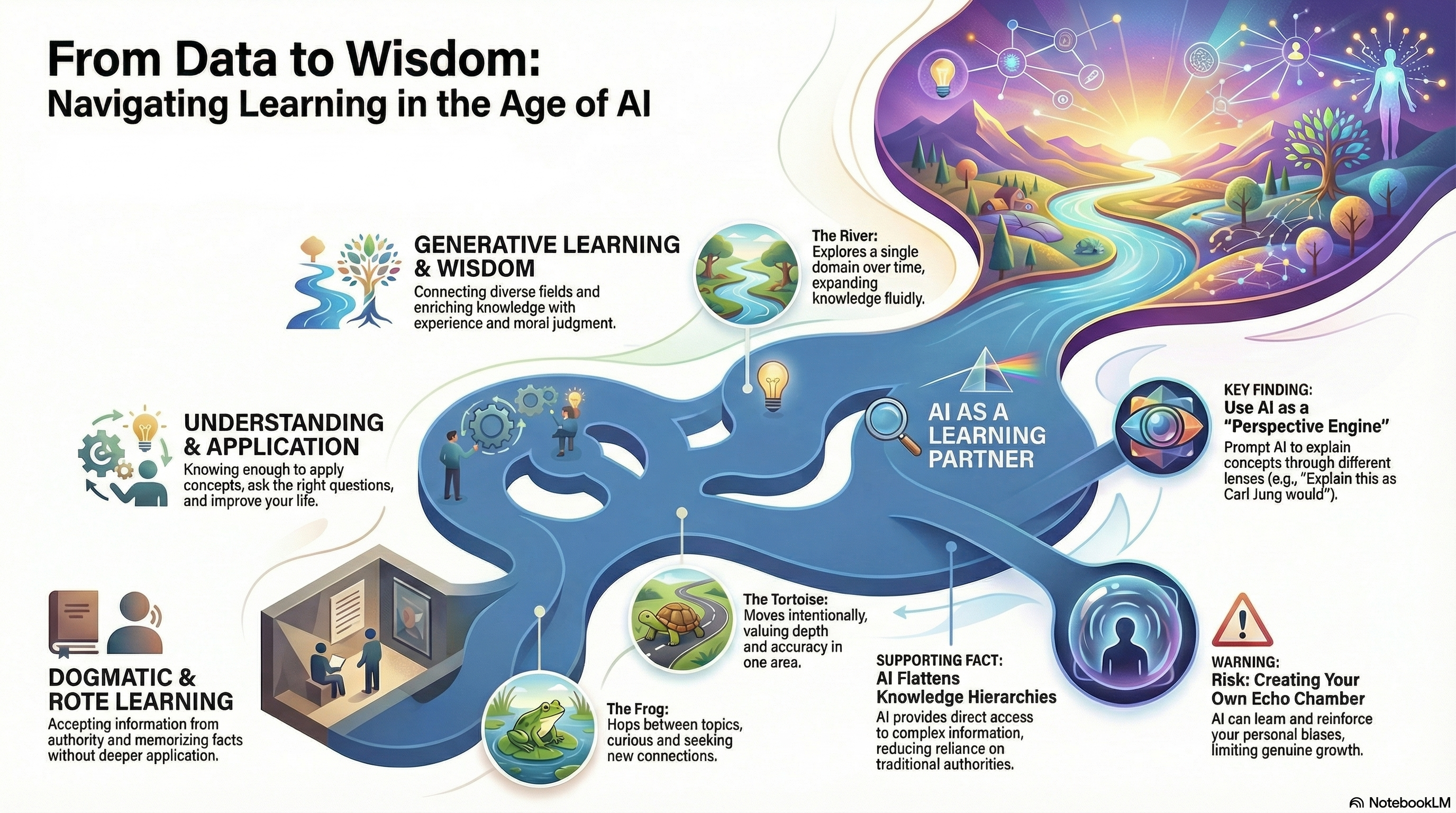
An old metaphor describes three distinct styles of learning. The Frog hops between topics, driven by a curiosity to discover new connections. The Tortoise moves slowly and deliberately, seeking depth and accuracy in a single subject. The River also explores one domain, but does so over a long period, letting knowledge flow and expand organically. While all styles have their merits, AI seems particularly useful for "frog learners." For those who thrive on connecting seemingly disparate fields, AI flattens the traditional hierarchy of knowledge. You no longer need a specific teacher or "fountain of knowledge" to draw a line between psychology and physics; AI provides immediate access, fueling that connective style of learning. This isn't just a semantic difference; it's a strategic shift. By recognizing AI as an exploratory partner, you can move beyond simple Q&A and fosters understanding to enjoy one’s personal life journey. 

To Get Better Answers, Give Your AI a Personality 

A common frustration with AI is getting generic or surface-level responses. A powerful technique to overcome this is to assign the AI a specific persona or identity within your prompt. Instead of asking a general question, you frame it through a specific lens, guiding the AI to access and structure its vast knowledge in a more sophisticated way. For example, you could prompt the AI with a scenario and add the instruction: "think of it as if you were Carl Jung...how would he explain this situation." This simple addition forces the model to filter its response through the concepts, vocabulary, and analytical framework of a specific thinker. This transforms your interaction with AI from a simple query to a simulated dialogue with a specific school of thought, unlocking layers of understanding that a generic prompt could never reveal. 

AI Has "Book Morality," Not Lived Wisdom 

It is critical to understand the difference between an AI's intelligence and genuine human wisdom. An AI's knowledge is built on statistical probability; its core function is to predict the most likely next word based on the immense dataset of books and text it was trained on. It doesn't "understand" in the human sense; it calculates. Consider Abraham Lincoln, a man who, like an AI, learned primarily from books. Yet, when Lincoln read Aesop's Fables, he didn't just process the words; he used them as a springboard for moral reflection and applied them to the crucible of his lived experience. An AI, by contrast, operates with what we might call a "book morality." It's the difference between a "book morality" and an "experiential morality." AI can tell you what is commonly written about a situation, but it hasn't lived through one. Recognizing this distinction is crucial; it helps us use AI for what it’s good at—summarizing collective knowledge—while reminding us to turn to human experience and introspection for genuine wisdom. 

The Most Powerful Learning Tool Isn't AI; It's Other People 

While AI can provide endless information, it cannot provide one of the most essential ingredients for deep learning: perspective. This is where Perspective Learning comes in, which is the act of understanding why another person's unique life experiences cause them to connect with information in a way you never could. It's about learning from the emotional and contextual story that shapes their perspective. When we listen to someone else's story, we don't just acquire facts; we gain insight into the emotional weight and personal history that gives those facts meaning. This enriches information with a depth AI cannot replicate. This insight repositions human conversation not as an alternative to AI, but as an essential, irreplaceable complement. While AI provides the data, people provide the meaning. "Oh, I would have never thought of that because I never...went through that situation to give me the skill or the insight to be able to see it that way or have that deeper connection." 

Use AI to Find the Signal, Not Just Add to the Noise 

In a world of information overload, it seems counter-intuitive that adding another information tool could bring clarity. Yet, when used intentionally, AI can be a powerful filter to reduce noise rather than contribute to it. Instead of endlessly scrolling through sensationalized news feeds, you can use AI to regain control of your information consumption. A practical example is to ask an AI for a non-sensationalized weekly news recap covering specific topics of interest. This allows you to stay informed on key events without the emotional hijacking of constant media consumption. By automating the mundane task of information filtering, we reclaim the cognitive bandwidth our brains need for their highest functions: creativity, imagination, and deep exploration—the very things that define our human intelligence. 

Conclusion: Your Uniquely Human Algorithm 

AI is a tool that is flattening knowledge hierarchies and empowering our natural curiosity in ways not since the Gutenberg Press made different perspectives through books accessible. It can serve as a research assistant, a brainstorming partner, and a filter for the noise of the modern world. It allows us to be the "frog learner," making connections we might never have found on our own. However, the path from knowledge to wisdom remains deeply human. True understanding is not built on data alone but is enriched by experience, empathy, and connection with others. AI can process information on the web, but it cannot replicate the insights gained from a single human life. AI can give you the 'what' of global knowledge. But only you can cultivate the 'why' this knowledge matters to you. As you delegate your information gathering, what is one conversation you will have, or one experience you will seek out this week, to invest in your uniquely human algorithm?

28Sep

 Anyone who has shared their life with a dog knows the experience: you look into their eyes and can't help but wonder what’s really going on in their mind. For centuries, our understanding of the canine inner world was based on intuition and anecdote. But in recent years, modern science has begun to provide concrete answers, using tools from genetics to fMRI to reveal a relationship even more complex and fascinating than we ever imagined.  The evidence reveals that the bond with your dog is a marvel of co-evolution, written in their muscles, their genes, and the very wiring of their brain. Let's explore five discoveries about our dogs. 

1. Those “Puppy Dog Eyes” Are a Real, Evolved Superpower 

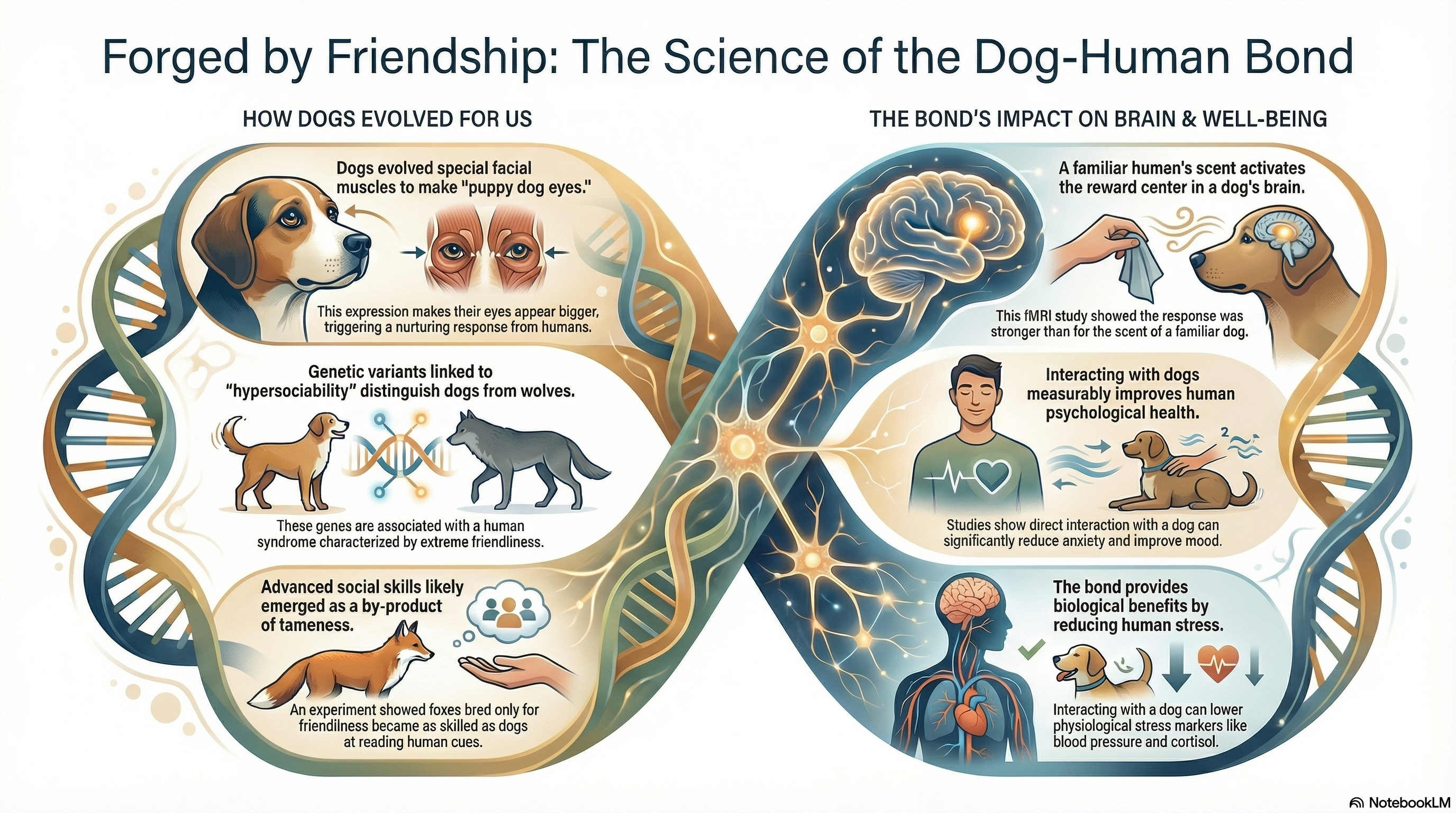
That irresistible "puppy dog eyes" expression—the one that melts hearts and secures extra treats—is not an accident. It’s a specific anatomical superpower that dogs evolved to communicate with humans. A study led by comparative psychologist Juliane Kaminski compared the facial anatomy of domestic dogs and their wolf ancestors. The dissections revealed a striking difference centered on a muscle above the inner eyebrow called the levator anguli oculi medialis (LAOM). This muscle was uniformly present in the dogs, but in their wolf ancestors, it was a mere shadow of itself—a disorganized smattering of muscle and connective tissue fibers. This muscle gives dogs an incredible new ability: to raise their inner eyebrows with an intensity their wolf cousins can't match. Behavioral data from the same study confirmed that dogs produce this movement significantly more often and with higher intensity than wolves do. In fact, the most intense eyebrow raises were produced exclusively by dogs. This expression has a powerful effect on people. It makes a dog's eyes appear larger and more infant-like, and it mimics an expression humans make when they are sad. Researchers hypothesize that this triggers a nurturing, caregiving response in humans, giving dogs who could make this face a powerful selective advantage during the 33,000-year course of domestication. 

2. To Your Dog, You Smell Better Than Anyone—Even Other Dogs 

If you asked a dog what the best smell in the world is, what would it be?  Research using fMRI (functional Magnetic Resonance Imaging) technology suggests the answer is, unequivocally, you. Neuroscientist Gregory Berns and his team trained dogs to lie perfectly still in an fMRI scanner—awake and unrestrained—to see how their brains respond to different scents. While in the scanner, the dogs were presented with scents from themselves, a familiar dog, a strange dog, a strange human, and a familiar human from their household. When researchers analyzed the brain's primary reward center—the caudate nucleus—they found it was activated by all the scents. However, it showed the maximal activation in response to the scent of the familiar human. This positive response was even stronger than the one elicited by the scent of a familiar dog. What makes this even more profound is that the 'familiar human' scent didn't belong to the dog's primary handler who was with them at the scanner. This proves the dog's brain wasn't just reacting to a person who was physically present; the scent alone, a stand-in for a beloved member of their 'pack,' was enough to trigger the brain's reward system like nothing else. As the researchers concluded: The caudate activation suggested that not only did the dogs discriminate that scent from the others, they had a positive association with it. This speaks to the power of the dog’s sense of smell, and it provides important clues about the importance of humans in dogs’ lives. 

3. Their Social Smarts May Be a By-Product of Extreme Friendliness 

It's a common assumption that dogs were directly bred for intelligence—that our ancestors selected for canines that were best at understanding commands. The science, however, suggests a more fascinating and indirect path. Dogs’ ability to read our cues may actually be a side effect of being bred for something else entirely: an exceptionally friendly temperament. The first clue comes from a famous long-term experiment on silver foxes. Researchers led by Brian Hare found that foxes bred only for tameness (low fear and aggression toward humans) spontaneously became as skilled as dog puppies at using human communicative gestures, like pointing to find hidden food. This suggests that complex social-cognitive skills can emerge as a "correlated by-product" of selection for friendliness, without any direct selection for "genius." This behavioral evidence was a stunning clue, but the genetic explanation that followed was even more so. Scientists discovered that this "friendliness-first" evolution has a precise genetic signature. A study by Bridgett vonHoldt and colleagues identified a key to dog behavior as "hypersociability"—an exaggerated motivation to seek social contact. They discovered that structural variants in two genes, GTF2I and GTF2IRD1, contribute to this trait. Astonishingly, these are the same genes associated with Williams-Beuren syndrome in humans, a genetic condition also characterized by hypersociability and extreme friendliness. It seems that during domestication, evolution targeted a genetic blueprint for an intensely social personality. A dog’s incredible ability to understand our intentions wasn't the direct goal of selection; it came along for the ride. 

4. They Don’t Just Read Your Mood, They Use It to Make Decisions 

Many dog owners feel certain their dog can sense their emotions. Science not only confirms this but shows that this ability is far more sophisticated than simple perception. Dogs actively use the emotional information they gather from us to make decisions and solve problems. A comprehensive review by Natalia Albuquerque and Briseida Resende highlights that dogs are adept at discriminating emotional cues from human facial expressions, body postures, and even our scent. But crucially, they put this information to functional use. One clear example comes from a 2013 study by Buttelmann & Tomasello. Dogs were shown two boxes, only one of which contained hidden food. To help them choose, a human would look into each box and display either a happy or a disgusted facial expression. The dogs consistently used these emotional cues to correctly identify the box with the food. Further evidence of this functional understanding comes from a behavior known as "mouth-licking." A 2018 study by Albuquerque and colleagues found that dogs exhibit this behavior significantly more when looking at human faces showing negative emotions (like anger) compared to happy ones. This suggests they aren't just seeing a face; they are processing its emotional meaning and responding accordingly. 

5. The "Love Hormone" Story Isn't as Simple as It Seems 

The idea of oxytocin as the "love hormone" has become a popular narrative to explain the dog-human bond. The story goes that when owners and dogs gaze at each other or interact affectionately, both experience a surge of oxytocin, creating a positive feedback loop that strengthens their bond. While compelling, the science is actually far from settled. A 2019 study by Sarah Marshall-Pescini and her colleagues provided a scientific reality check. They carefully designed an experiment to measure oxytocin in both dogs and their owners before and after a positive, affectionate interaction. In stark contrast to some previous reports, they were unable to find a significant increase in peripheral oxytocin levels (measured in urine) in either species. This doesn't mean oxytocin plays no role, but it highlights that the relationship is more complex than the simple pop-science narrative suggests. The researchers point out that findings across the field are mixed. Discrepancies could be due to differences in laboratory analysis methods or the ongoing scientific debate about how well peripheral measures in saliva or urine actually reflect what’s happening in the brain. This discovery is a perfect example of the scientific process in action: an exciting initial idea is tested, re-tested, and refined, leading to a more nuanced and accurate understanding over time. 

Conclusion: A Bond Forged in Science Science confirms what we've always felt: the bond with a dog is something special. But the reality is more astonishing than we could have guessed. The connection we share isn't just a matter of affection, but a product of remarkable and intertwined biological, genetic, and behavioral changes. That their brain's reward center lights up for our scent more than any other, or that their very facial muscles evolved to better communicate with us, doesn't diminish the magic of the relationship; it makes it all the more profound. As we continue to unravel the science behind our oldest friendship, what other incredible secrets are our canine companions just waiting for us to discover?

27Sep

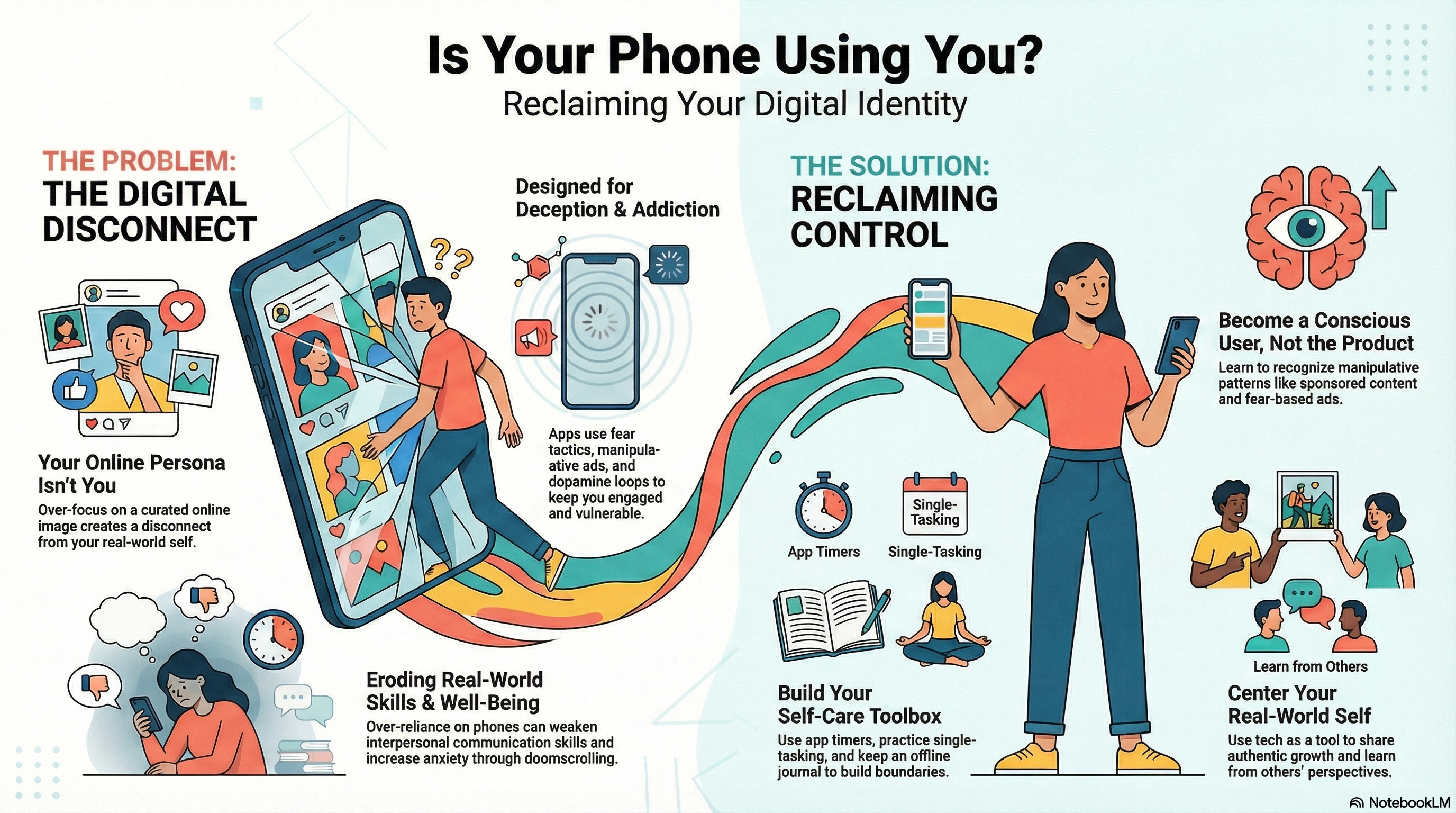
The smartphone has been seamlessly integrated as a cybernetic extension of the self. It’s the first thing we reach for in the morning and the last thing we see at night, a constant companion holding our memories, connections, and identity. We perceive it as an indispensable tool for navigating the modern world, a simple device under our command. But as our dependence deepens, a crucial question emerges: are we truly in control? Or is the device in our pocket subtly controlling us, rewiring our brains, and reshaping who we are? Drawn from a candid conversation with a tech insider on the front lines of consumer behavior, here are five impactful ways your phone is changing you. 

1. You're Cultivating a "Second Self" Online—And Preferring It A growing separation is occurring between our online persona and our actual self in the present moment. Increasingly, our focus shifts from experiencing life to documenting it, driven by an intense concern for how we are perceived in the virtual world. This creates a profound identity schism, where the curated, digital self begins to cannibalize the authentic, lived experience. This curated life, presented through carefully selected photos and posts, can become more valuable than the lived experience itself. The priority becomes capturing the perfect picture of an event rather than being fully present in it. As this digital representation gains importance, it makes us vulnerable. We are lured into perfecting this second self, which in turn exposes us to systems designed to exploit our need for validation. The consequence of this separation is a diminished capacity for personal growth. When a mistake happens in the real world but isn't captured online, it can feel as if it "didn't matter." Without a digital record, there's no perceived need to learn from the experience or consider how to do better in the future. They just have the representation on the phone and they would rather be okay with that self than the actual self that was in the current moment. So, it's almost like another persona. 

2. The Phone Isn't Just Using You; It's Preying on Your Fears Many users are unaware of the manipulative business models that power the "free" apps on their phones, especially older generations who didn't grow up with this technology. The old adage of commercialism applies: "if you don't pay for the product then you are the product." Your attention and data are the currency. A clear example of this is the proliferation of fear-tactic ads. You’ve likely seen them: a pop-up window blares a warning that "your phone has a virus." These ads are designed to trigger fear and bypass logical thinking, tricking users into downloading malicious "cleaning" apps. Instead of helping, these apps often clog the phone, sell personal data, or lock users into unwanted subscriptions. It's critical to understand the "why" behind what appears on your screen. These systems are not just business models; they are manipulative frameworks that can have profound societal consequences. Sponsored content and fear-based ads are not there for your benefit. They are engineered for corporate gain, preying on a lack of technical literacy to extract value. 

3. Your Brain is Being Rewired for a Never-Ending Dopamine Hunt Once we are hooked on curating and protecting our digital selves, platforms keep us engaged by rewiring our brains for a constant dopamine hunt. The design of many popular apps encourages "endlessly scrolling," a behavior that trains the brain to constantly seek the next small reward. These platforms have identified a potent emotional cocktail for engagement, often centered on drama, news and politics, or criticism. This constant intake of highly charged, often negative, stimuli becomes a primary source of validation for many. The more we rely on this external validation from our phones, the more we distance ourselves from our own internal state, reinforcing the cycle of dependence. This has physiological consequences. The habit of "doom scrolling" before bed, for instance, floods the body with the stress hormone cortisol right when it should be winding down. This not only disrupts sleep but also negatively impacts long-term physical and mental health. 

4. We're Outsourcing Our Most Human Skills As we rely more on technology to handle daily tasks, we risk losing fundamental human abilities. A simple example is navigation. Where we once used physical maps to understand our location, we now plug an address into an app and follow its commands, losing a basic sense of spatial awareness. More critically, we are seeing an erosion of vital interpersonal skills. Many people now prefer texting to phone calls, a shift that strips communication of essential human elements like tone and inflection, leading to disconnect and misunderstanding. The anonymity of communicating from behind a screen can also foster vitriol, as people feel emboldened to say things they never would face-to-face. The erosion of these vital skills is so pronounced that one tech insider stated it plainly: "We kind of are losing the skill of interpersonal communication. 100%." Interestingly, technology sometimes offers a partial remedy; the use of voice memos, for example, can reintroduce the nuance of audible inflection. 

5. The Best Tool for a Healthier Tech Life Isn't an App—It's You It’s a paradox: we turn to technology to solve the problems it creates, downloading another self-care app in the hope of finding an external fix. Our environment conditions us to look for such solutions. The real answer, however, is not external. It's about building the internal skills for self-regulation. This shift from external fixes to internal strength is powerfully illustrated by this story. After years on and off various prescriptions without finding lasting success, true mental stability came not from a pill, but from consciously building a "relationship with stability." This was achieved through practices like Dialectical Behavioral Therapy (DBT) and mindfulness, which focus on internal communication and awareness. This journey is about understanding how your own brain processes information and being conscious of your internal state. Instead of turning to another app that can become a distraction, the most effective methods are often analog. Practical tools like setting firm app timers and keeping a physical notebook for journaling allow for focused self-reflection without the temptation of getting pulled back into the digital world. 

Conclusion: Reclaiming Your Attention The architecture of our digital lives is not accidental; it is a landscape engineered for extraction. Our phones are powerful, but their default settings are designed to capture our attention, reshape our habits, and monetize our behavior. From cultivating a preferred digital self to rewiring our brains for constant stimulation, the effects are subtle but profound. Being aware of these mechanisms is the first step toward reclaiming our agency. The next time you pick up your phone, ask yourself: Are you using it as a tool, or is it using you?

19Aug

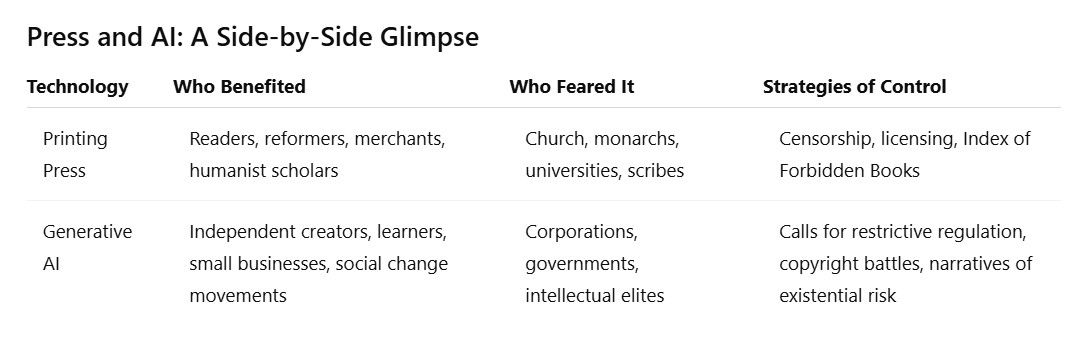
 Democratizing Information 

When Johannes Gutenberg unveiled his movable-type printing press in the mid-15th century, few could have imagined how profoundly it would reshape society. What seemed at first to be a technical innovation in book production soon proved to be one of the most disruptive forces in human history. The press democratized access to knowledge, lowered the cost of books, and fueled literacy and the spread of ideas that ignited the Renaissance. Yet it also provoked fear. Authorities—both religious and political—recognized the printing press as a threat to their control over information and attempted to contain it through censorship, licensing, and even book burnings. The story of the printing press is not just a historical curiosity. It offers a striking parallel to our current moment with generative AI. Much like the press, AI is a technology that enables alterity—radical change that challenges existing systems, hierarchies, and accessibility to information. Alterity here means more than just “otherness”; it describes the transformative potential of a new way of producing and sharing knowledge. 

Who Resisted the Printing Press 

  • Religious authorities: The Catholic Church had long controlled access to scripture and its interpretation. The press broke that monopoly, enabling vernacular translations of the Bible and fueling the Protestant Reformation.
  • Political authorities: Monarchs feared that dissenting or revolutionary ideas could spread too quickly to contain. Early presses faced licensing requirements and censorship.
  • Knowledge gatekeepers: Monasteries, universities, and scribes who had once mediated access to texts found their influence diminished.

 Who Resists Generative AI 

  • Corporations: Media and tech companies fear loss of control over content, profits, and intellectual property. Ironically, some of the loudest voices warning of AI’s dangers come from within Big Tech itself—often in ways that could cement their control by shaping regulation.
  • Political leaders: Democracies fear AI-driven misinformation; authoritarian states fear its potential to weaken censorship and empower dissent.
  • Intellectual gatekeepers: Scholars, journalists, and cultural critics worry about the erosion of expertise, authorship, and human creativity.
  • Ethical doomsayers: Some warn of existential risks, framing AI as a possible extinction-level threat. These narratives often capture attention, funding, and influence.

 The Deeper Pattern: Knowledge and Power

At its core, resistance of disruptive technology reflects a deeper pattern: the loss of control over knowledge. In Gutenberg’s time, the ability to read, interpret, and spread ideas moved from a select elite to the broader public. Today, generative AI similarly lowers barriers to content creation, analysis, and creativity. When everyone can generate ideas, summaries, art, or even code, the monopoly of traditional gatekeepers is destabilized.

Using Generative AI Positively

Rather than seeing AI only through a lens of fear, we can embrace it as a tool for learning, connection, and creativity. Here are a few practical ways to use it constructively: 

  • Foster dialogic learning: Use AI to spark conversations, pose multiple perspectives, and support reflective dialogue.
  • Assess for misinformation: Use AI as a tool to cross-check claims and strengthen critical thinking about sources.
  • Generate better questions: Let AI help formulate thoughtful questions that improve human interaction and discussion.
  • Support reading comprehension: Read a book and use AI to generate a clear, accessible summary to reinforce understanding.
  • Create non-sensationalized news summaries: Use AI to distill current events into balanced, fact-based summaries that avoid sensationalism and reduce stress.

 A Closing Thought 

The printing press reminds us that disruptive technologies are not inherently good or bad. They are tools that enable alterity—a break from the old order, with both liberating and unsettling effects. Generative AI, like the press, will expand access to knowledge while provoking those invested in gatekeeping to amplify fears. The challenge for us today is to recognize the resistance for what it often is: a defense of power and profit. And the opportunity is to ask—how can we use this technology to broaden human potential, deepen well-being, and write a new chapter of collective learning? 

Alterity Technology that enables alterity can be understood as technology that democratizes generative learning, creating access for more people to produce and share knowledge, and in doing so, has the potential to radically change existing systems of power, authority, and culture. 

At Next Level Safety, we believe technology can serve community well-being when AI is used in a safe and ethical manner. 

Article in Accessibility View