13Jan

Empathy is a word we hear everywhere—praised in workplaces, taught in schools, and often described as a foundation of a healthy society. It is commonly treated as a timeless virtue and a straightforward human trait. But when we look more closely at where the concept comes from and how it actually functions, a more nuanced picture begins to emerge.The story of empathy is less simple than its popularity suggests. Its roots lie not in psychology but in art theory. Its mechanisms are embedded in our nervous system. And its expression is shaped—often invisibly—by bias, context, and experience. What follows are six research-informed findings about empathy, drawn from history, neuroscience, and psychology, that help clarify what empathy is, where it came from, and how it operates in everyday life.

1. Empathy Is a Relatively Modern Concept with Artistic Origins

One surprising finding about empathy is how recent the word itself is. The English term empathy entered the language around 1908 as a translation of the German word Einfühlung, meaning “in-feeling.” The idea was introduced decades earlier, in 1858, by philosopher Rudolf Lotze—not to explain human relationships, but to describe how people experience art.

Einfühlung referred to the act of projecting one’s own feelings into a painting, sculpture, or even an inanimate object. Later, psychologist Theodor Lipps expanded the concept to include how people understand one another’s inner experiences. Edward Bradford Titchener ultimately introduced empathy into English to capture this phenomenon.

This historical finding is revealing. Empathy was never about becoming another person or absorbing their emotions entirely. From its earliest use, it described understanding while maintaining distinction—a theme that becomes important when empathy is confused with sympathy.

“Not only do I see gravity and modesty and pride and courtesy and stateliness, but I feel or act them in the mind's muscles… a simple case of empathy.”
— Edward Bradford Titchener, 1909

2. Empathy Differs from Sympathy in How It Relates to Suffering

Another key finding is that empathy and sympathy, though often used interchangeably, describe different psychological processes. A common metaphor helps clarify the distinction. Imagine someone has fallen into a deep pit.

  • Pity remains above, observing from a distance and expressing concern without engagement.
  • Sympathy enters the pit to suffer alongside the person, sharing emotional distress.
  • Empathy stays at the edge, understands what being in the pit is like, and offers support without taking on the suffering as its own.

This finding highlights empathy as a form of “engaged detachment.” It allows for understanding another person’s experience from within their perspective while maintaining enough distance to remain effective and grounded.

“[Empathy is] consideration of another person’s feelings… without making his or her burden one’s own.”
— Alberta Szalita, Psychiatrist, 1976

3. Empathy Has a Measurable Neurological Basis

Research in neuroscience supports the finding that empathy is not merely a social convention or learned behavior, but a biological capacity. Human survival has long depended on cooperation, and the brain reflects this evolutionary history.

When people observe others performing actions or experiencing pain, similar neural networks activate in the observer’s brain. Studies have shown that watching someone’s hand being pricked by a needle stimulates regions associated with pain perception. In other research, individuals showed activation in pain-related brain areas when they believed a loved one was experiencing discomfort.

This finding explains why empathic responses feel immediate and physical. At the same time, the brain dampens these responses, allowing people to register another’s experience without becoming overwhelmed—supporting connection without emotional overload.

4. Empathy Can Be Developed—and Can Also Decline

A common assumption is that empathy is a fixed personality trait. Research challenges this view. One important finding is that empathy functions more like a skill than an inherent quality. Studies in medical education, for example, have documented a decline in empathy during training. This decrease is associated with lower patient satisfaction, reduced trust, and poorer adherence to treatment recommendations. These findings suggest that empathy strengthens with intentional practice and weakens when ignored or suppressed. It is not lost because it was never there, but because the conditions needed to sustain it are absent.

5. Empathy Is Influenced by Bias and Group Boundaries

Another well-established finding is that empathy is not evenly distributed. People tend to experience stronger emotional resonance with those they perceive as similar or familiar. This pattern has evolutionary roots and is reinforced by social conditioning.

The brain’s threat detection systems can react to perceived differences almost instantaneously, sometimes before conscious reasoning occurs. As a result, empathic responses toward perceived “outsiders” may be reduced or blocked.

Research also points to a pathway beyond this limitation. Cognitive empathy—deliberate perspective-taking—can override automatic bias. Studies by social psychologist C. Daniel Batson indicate that intentionally valuing the well-being of others can generate genuine empathic concern, even across social or cultural divides.

6. Sustained Empathy Depends on Self-Empathy

A final finding is that empathy has limits. Emotional capacity is finite, and chronic stress or emotional overload reduces the ability to respond empathically. This pattern is especially evident in caregiving and service professions.

Self-empathy—the practice of extending understanding and care toward one’s own experience—plays a critical role in sustaining empathy over time. Rather than being self-centered, self-empathy supports resilience and prevents burnout, making it possible to continue offering care to others.

“Love and compassion are necessities, not luxuries. Without them humanity cannot survive.”
— The Dalai Lama

Conclusion: Applying These Findings in Practice

Taken together, these findings suggest that empathy is neither automatic nor limitless. It is a complex human capacity shaped by history, biology, learning, and context. It can be strengthened through intention, weakened through neglect, and misdirected by bias.

Understanding empathy in this way reframes it from a passive virtue into an active skill—one that benefits from awareness, practice, and care. Rather than asking whether we “have” empathy, these findings invite a more practical question: how are we choosing to use and sustain it?

References

Burton, N. (2024, June 24). The difference between empathy and sympathy. Psychology Today.

Empathy. (n.d.). In Online Etymology Dictionary.

Hardee, J. T. (2003). An overview of empathy. The Permanente Journal7(4), 51–54.

Riess, H. (2017). The science of empathy. Journal of Patient Experience4(2), 74–77. https://doi.org/10.1177/2374373517699267

28Sep

 Anyone who has shared their life with a dog knows the experience: you look into their eyes and can't help but wonder what’s really going on in their mind. For centuries, our understanding of the canine inner world was based on intuition and anecdote. But in recent years, modern science has begun to provide concrete answers, using tools from genetics to fMRI to reveal a relationship even more complex and fascinating than we ever imagined.  The evidence reveals that the bond with your dog is a marvel of co-evolution, written in their muscles, their genes, and the very wiring of their brain. Let's explore five discoveries about our dogs. 

1. Those “Puppy Dog Eyes” Are a Real, Evolved Superpower 

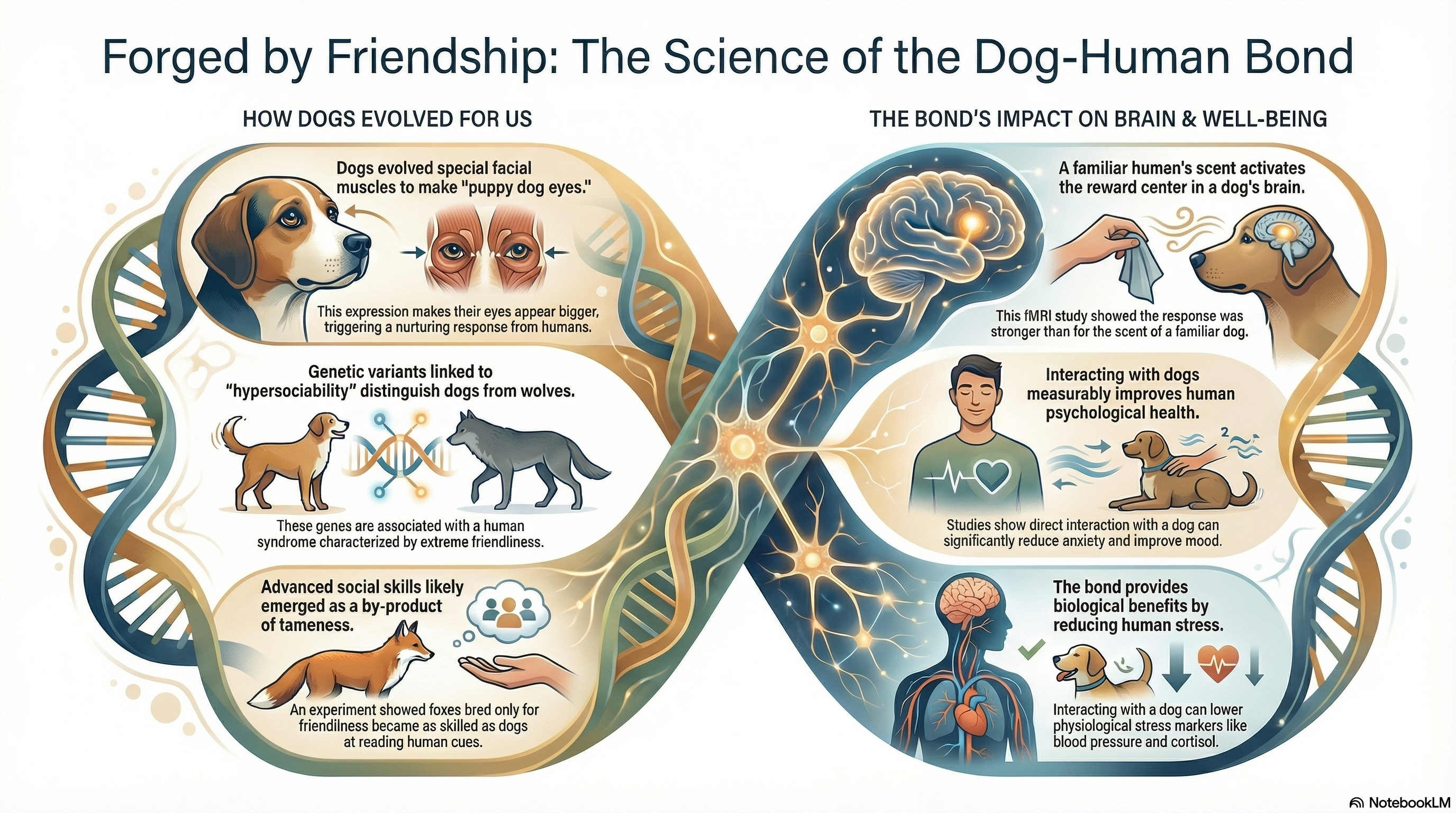
That irresistible "puppy dog eyes" expression—the one that melts hearts and secures extra treats—is not an accident. It’s a specific anatomical superpower that dogs evolved to communicate with humans. A study led by comparative psychologist Juliane Kaminski compared the facial anatomy of domestic dogs and their wolf ancestors. The dissections revealed a striking difference centered on a muscle above the inner eyebrow called the levator anguli oculi medialis (LAOM). This muscle was uniformly present in the dogs, but in their wolf ancestors, it was a mere shadow of itself—a disorganized smattering of muscle and connective tissue fibers. This muscle gives dogs an incredible new ability: to raise their inner eyebrows with an intensity their wolf cousins can't match. Behavioral data from the same study confirmed that dogs produce this movement significantly more often and with higher intensity than wolves do. In fact, the most intense eyebrow raises were produced exclusively by dogs. This expression has a powerful effect on people. It makes a dog's eyes appear larger and more infant-like, and it mimics an expression humans make when they are sad. Researchers hypothesize that this triggers a nurturing, caregiving response in humans, giving dogs who could make this face a powerful selective advantage during the 33,000-year course of domestication. 

2. To Your Dog, You Smell Better Than Anyone—Even Other Dogs 

If you asked a dog what the best smell in the world is, what would it be?  Research using fMRI (functional Magnetic Resonance Imaging) technology suggests the answer is, unequivocally, you. Neuroscientist Gregory Berns and his team trained dogs to lie perfectly still in an fMRI scanner—awake and unrestrained—to see how their brains respond to different scents. While in the scanner, the dogs were presented with scents from themselves, a familiar dog, a strange dog, a strange human, and a familiar human from their household. When researchers analyzed the brain's primary reward center—the caudate nucleus—they found it was activated by all the scents. However, it showed the maximal activation in response to the scent of the familiar human. This positive response was even stronger than the one elicited by the scent of a familiar dog. What makes this even more profound is that the 'familiar human' scent didn't belong to the dog's primary handler who was with them at the scanner. This proves the dog's brain wasn't just reacting to a person who was physically present; the scent alone, a stand-in for a beloved member of their 'pack,' was enough to trigger the brain's reward system like nothing else. As the researchers concluded: The caudate activation suggested that not only did the dogs discriminate that scent from the others, they had a positive association with it. This speaks to the power of the dog’s sense of smell, and it provides important clues about the importance of humans in dogs’ lives. 

3. Their Social Smarts May Be a By-Product of Extreme Friendliness 

It's a common assumption that dogs were directly bred for intelligence—that our ancestors selected for canines that were best at understanding commands. The science, however, suggests a more fascinating and indirect path. Dogs’ ability to read our cues may actually be a side effect of being bred for something else entirely: an exceptionally friendly temperament. The first clue comes from a famous long-term experiment on silver foxes. Researchers led by Brian Hare found that foxes bred only for tameness (low fear and aggression toward humans) spontaneously became as skilled as dog puppies at using human communicative gestures, like pointing to find hidden food. This suggests that complex social-cognitive skills can emerge as a "correlated by-product" of selection for friendliness, without any direct selection for "genius." This behavioral evidence was a stunning clue, but the genetic explanation that followed was even more so. Scientists discovered that this "friendliness-first" evolution has a precise genetic signature. A study by Bridgett vonHoldt and colleagues identified a key to dog behavior as "hypersociability"—an exaggerated motivation to seek social contact. They discovered that structural variants in two genes, GTF2I and GTF2IRD1, contribute to this trait. Astonishingly, these are the same genes associated with Williams-Beuren syndrome in humans, a genetic condition also characterized by hypersociability and extreme friendliness. It seems that during domestication, evolution targeted a genetic blueprint for an intensely social personality. A dog’s incredible ability to understand our intentions wasn't the direct goal of selection; it came along for the ride. 

4. They Don’t Just Read Your Mood, They Use It to Make Decisions 

Many dog owners feel certain their dog can sense their emotions. Science not only confirms this but shows that this ability is far more sophisticated than simple perception. Dogs actively use the emotional information they gather from us to make decisions and solve problems. A comprehensive review by Natalia Albuquerque and Briseida Resende highlights that dogs are adept at discriminating emotional cues from human facial expressions, body postures, and even our scent. But crucially, they put this information to functional use. One clear example comes from a 2013 study by Buttelmann & Tomasello. Dogs were shown two boxes, only one of which contained hidden food. To help them choose, a human would look into each box and display either a happy or a disgusted facial expression. The dogs consistently used these emotional cues to correctly identify the box with the food. Further evidence of this functional understanding comes from a behavior known as "mouth-licking." A 2018 study by Albuquerque and colleagues found that dogs exhibit this behavior significantly more when looking at human faces showing negative emotions (like anger) compared to happy ones. This suggests they aren't just seeing a face; they are processing its emotional meaning and responding accordingly. 

5. The "Love Hormone" Story Isn't as Simple as It Seems 

The idea of oxytocin as the "love hormone" has become a popular narrative to explain the dog-human bond. The story goes that when owners and dogs gaze at each other or interact affectionately, both experience a surge of oxytocin, creating a positive feedback loop that strengthens their bond. While compelling, the science is actually far from settled. A 2019 study by Sarah Marshall-Pescini and her colleagues provided a scientific reality check. They carefully designed an experiment to measure oxytocin in both dogs and their owners before and after a positive, affectionate interaction. In stark contrast to some previous reports, they were unable to find a significant increase in peripheral oxytocin levels (measured in urine) in either species. This doesn't mean oxytocin plays no role, but it highlights that the relationship is more complex than the simple pop-science narrative suggests. The researchers point out that findings across the field are mixed. Discrepancies could be due to differences in laboratory analysis methods or the ongoing scientific debate about how well peripheral measures in saliva or urine actually reflect what’s happening in the brain. This discovery is a perfect example of the scientific process in action: an exciting initial idea is tested, re-tested, and refined, leading to a more nuanced and accurate understanding over time. 

Conclusion: A Bond Forged in Science Science confirms what we've always felt: the bond with a dog is something special. But the reality is more astonishing than we could have guessed. The connection we share isn't just a matter of affection, but a product of remarkable and intertwined biological, genetic, and behavioral changes. That their brain's reward center lights up for our scent more than any other, or that their very facial muscles evolved to better communicate with us, doesn't diminish the magic of the relationship; it makes it all the more profound. As we continue to unravel the science behind our oldest friendship, what other incredible secrets are our canine companions just waiting for us to discover?