30Dec

An Analysis of Spirituality and Modern Life 

Joseph Campbell is best known for his work on ancient myths, but his real relevance today may be how clearly he saw the problems of modern life coming. Long before burnout, anxiety, and “purpose culture” became everyday topics, Campbell was asking a deeper question: What happens to people when the stories that once gave life meaning stop working?

Campbell believed that myths were never just old stories. In traditional societies, they functioned like a shared operating system. They explained how the world worked, what mattered, how to live a meaningful life, and how to face suffering and death. You didn’t have to invent meaning on your own—it was built into the culture, the rituals, and the rhythms of daily life.

Modern life, Campbell argued, quietly dismantled that shared framework.
Losing the Big Story

According to Campbell, modern societies didn’t just outgrow myth—they outpaced it. Science gave us extraordinary knowledge about how the universe works, but it didn’t replace the symbolic stories that helped people feel connected to life itself. At the same time, rapid technological change, global pluralism, and individualized identity made it impossible for any single shared myth to hold society together.

The result wasn’t freedom alone—it was fragmentation.

Myth didn’t disappear; it became personal. Each individual was suddenly responsible for figuring out who they are, what matters, and why life is worth living. That shift can be liberating, but it also leaves people unmoored. When there’s no shared symbolic grounding, people naturally look for substitutes. Political ideologies, conspiracy narratives, and extreme forms of nationalism often rush in to fill the gap. They offer identity, purpose, and a clear “us vs. them” story—but without the depth or humility of true myth.Campbell saw this not as a moral failure, but as a structural vulnerability.

Purpose vs. Being Alive

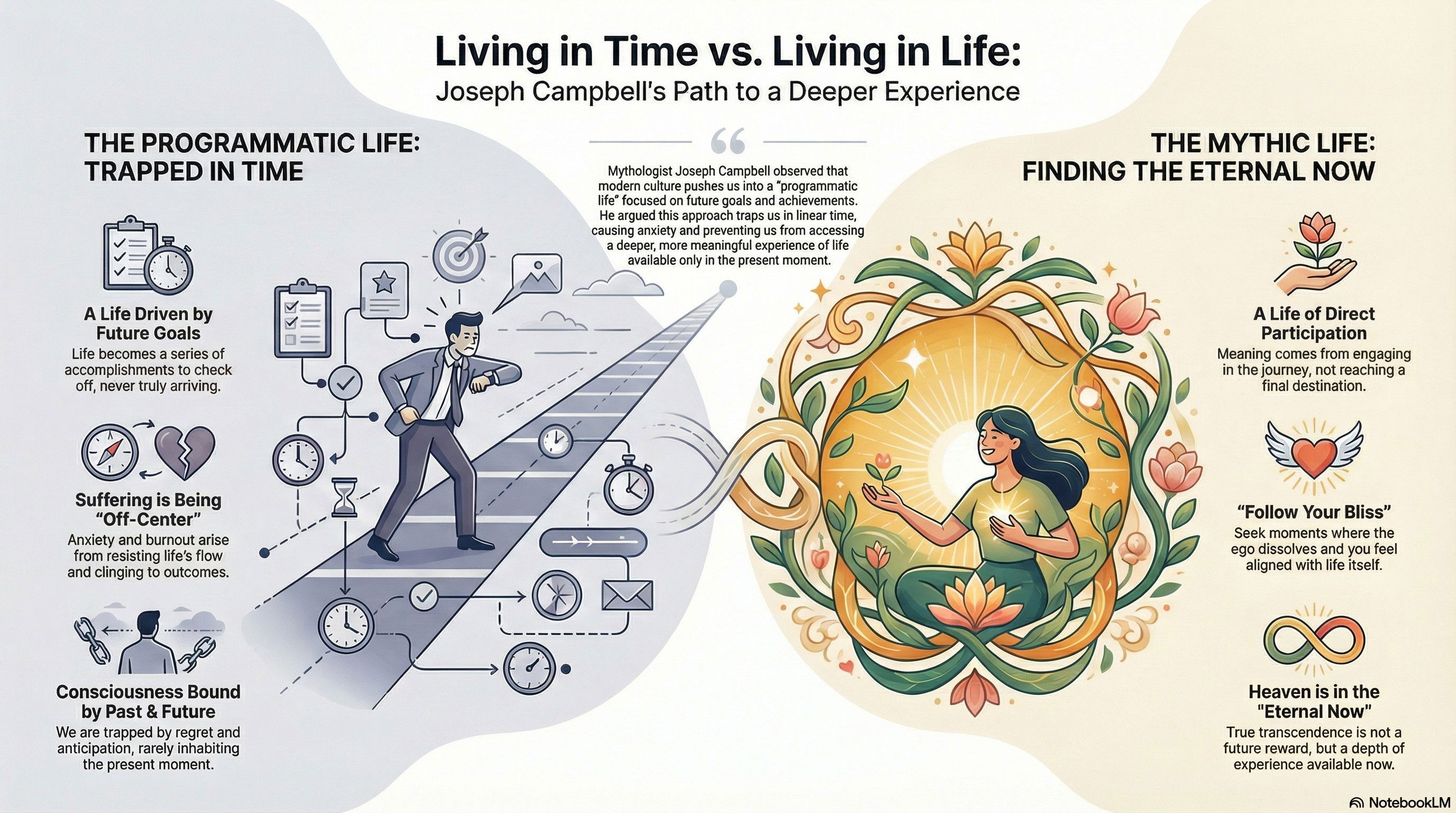
One of Campbell’s most challenging ideas is his skepticism toward the modern obsession with “finding your purpose.” He believed that chasing meaning as a goal often pulls people away from life rather than deeper into it.

We tend to treat meaning like a destination: Once I figure out my purpose, then life will make sense. Campbell thought this mindset turns life into a project instead of an experience. It keeps us mentally living in the future rather than fully present in the moment.

This is where his famous phrase “follow your bliss” is often misunderstood. He wasn’t talking about happiness, success, or self-indulgence. He was pointing to moments when the constant self-monitoring quiets down—when you’re so engaged that you forget yourself and feel fully alive. Bliss, for Campbell, was about participation, not achievement.

Seen alongside Viktor Frankl’s work, the contrast becomes clearer. Frankl showed how searching for meaning can help people survive unimaginable suffering. Campbell didn’t deny that—but he warned against turning meaning into something rigid or final. Meaning can support us, but when we cling to it too tightly, it can also become another trap. Sometimes the search itself is the point.


The Problem with a Goal-Driven Life

Campbell was deeply critical of what he called “programmatic living”—a way of life organized almost entirely around goals, milestones, and future rewards. Modern culture trains us to think in timelines: Once I finish this… once I get there… once I achieve that…

The problem is that “there” never really arrives.

Life becomes a constant cycle of accomplishment followed by the next target. Instead of rituals, we have résumés. Instead of presence, we have productivity. Even time itself gets treated like a resource to manage, save, or optimize.

Campbell contrasted this with what he called the “eternal now.” He didn’t mean eternity as endless time in the future, but depth in the present. When we stop obsessing over what’s next, there’s a different quality of experience available—one where life feels fuller, richer, and more real.

Rethinking Suffering

Campbell didn’t believe suffering could—or should—be eliminated. What he challenged was how much of our suffering is amplified by resistance. When we’re tightly attached to outcomes, identities, and expectations, life constantly feels like it’s going wrong.

He described this state as being “off-center.” From that perspective, suffering isn’t a failure—it’s feedback. It shows where we’re clinging instead of participating. Pain may be unavoidable, but much of modern stress comes from trying to control life rather than live it.

The Cost of Living on Hold

Campbell’s lasting insight is that many of today’s mental and emotional struggles aren’t personal shortcomings. They’re the predictable result of a culture that keeps deferring life itself. We’re always preparing, optimizing, improving—but rarely arriving.

What religions once symbolized as heaven, Campbell suggested, was never meant to be a reward at the end of life. It was a way of pointing to the depth of life when it’s fully lived.In a world obsessed with progress, his work offers a quiet but radical reminder: life doesn’t begin later. It only happens now.
29Dec

When most people think of Dante Alighieri’s The Divine Comedy, they picture a grim and terrifying tour of Hell. The poem’s first section, Inferno, with its nine concentric circles of torment, has so thoroughly captured the popular imagination that its imagery has become synonymous with damnation itself. We envision fire, brimstone, and grotesque punishments tailored to every imaginable sin. 

Yet, to focus on the infernal machinery is to mistake the entryway for the entire cathedral. The poem's true purpose, revealed by its very title, is not to map damnation, but to chart a course for spiritual recovery. In Dante’s time, a "comedy" was not a story meant to be funny, but one that began in despair and confusion and ended in joy and enlightenment. The poem is an epic of transformation, an allegorical map of the soul’s journey out of a "dark wood" of personal crisis and toward cosmic harmony.

This 700-year-old masterpiece is far more than a historical artifact. It is a timeless exploration of human nature, morality, and the search for meaning. Our purpose here is to excavate several counter-intuitive truths about human nature and the soul's orientation toward meaning hidden within its verses.

1. It’s a "Comedy," But Not Because It's Funny

In the classical world, literary genres had specific structural definitions. A tragedy was a narrative that began in a state of happiness or order and ended in sorrow, ruin, or death. In contrast, a comedy began in a state of difficulty, chaos, or confusion but concluded with a joyful and enlightened resolution.The Divine Comedy is the quintessential example of this comedic form. Its three parts map a clear upward trajectory:

Inferno (Hell) represents the state of despair and being lost.

Purgatorio (Purgatory) represents the difficult process of struggle, cleansing, and transformation.

Paradiso (Paradise) represents the achievement of joy, meaning, and union with the divine.

This reframing is philosophically powerful. It suggests that hardship and confusion are not the tragic end of a story but the necessary first act. For Dante, life’s journey is not defined by the fall from grace but by the arduous, hopeful climb toward resolution. This structure is more than a literary device; it's a theological argument that the universe itself is fundamentally comedic, bending not toward chaos, but toward justice, love, and ultimate reconciliation.

2. The Worst Sins Aren’t Violence or Lust—They’re Betrayal

Dante’s Hell is structured with a precise moral logic: the further one descends, the more severe the sin. The upper circles punish sins of "incontinence"—failures of self-control like lust, gluttony, and wrath. While serious, Dante considers these sins of passion to be less corrupting than sins of malice, which involve the deliberate use of reason to harm others. 

The deepest and most terrible part of Hell is the Ninth Circle, reserved not for murderers or heretics, but for traitors. Here, there is no fire; the punishment is to be frozen in a lake of ice. The symbolism is stark: those who denied the warmth of love and trust in life are eternally deprived of it in death. At the very center of the universe, Satan himself is encased in ice, chewing on the three greatest traitors in history: Judas Iscariot (who betrayed Christ) and Brutus and Cassius (who betrayed Julius Caesar). 

For Dante, this was not a theoretical sin; as a man betrayed and exiled from his beloved Florence, he understood that treason was a cold poison that dissolves the very foundations of society and self. The ultimate corruption of the human spirit is not a crime of passion but the cold, calculated decision to betray a sacred trust.

3. Damnation Isn't a Punishment, It's a Choice

A central tenet of Dante’s vision is the sanctity of free will. It is the divine gift that makes us human, allowing us to choose our path. This concept radically reshapes the idea of damnation. In Dante's Inferno, souls are not in Hell because God sent them there as retribution; they are there because they have chosen to be.

The will of the souls in Hell is described as "hardened" and "unrepentant." They are frozen in their chosen sins, eternally clinging to the pride, envy, or anger that defined them in life. Crucially, they no longer want to change. In contrast, the souls in Purgatory are defined by a will that is "struggling, wounded, but healing." They willingly undergo painful purification because their will is now oriented toward the good. This journey of the will culminates in Paradise, where the soul’s desires become so perfectly aligned with divine love that it achieves true freedom—not by losing its will, but by fulfilling it completely.

Damnation, therefore, is not an external sentence but the internal state of a soul that has permanently locked itself away from change.

"A soul that clings to its sin and rejects transformation."

4. Human Reason Can Only Take You So Far

For the first two-thirds of his journey, Dante is led by the Roman poet Virgil, a figure he deeply admires as his master and guide. In the poem's allegory, Virgil represents the pinnacle of human reason, wisdom, and classical virtue. It is reason that allows Dante to understand the nature of sin in the Inferno and the process of moral correction in the Purgatorio.

But Virgil's guidance has a limit. As a virtuous pagan who lived before Christ, he cannot enter Paradise. At the gates of Heaven, he must turn back, and a new guide appears: Beatrice. A woman Dante loved from afar in his youth, Beatrice is transfigured in the poem into a symbol of immense power.

This transition is one of the most significant moments in the work. It signifies that while human reason is essential for navigating the moral world and understanding our own failings, it is ultimately insufficient for achieving true spiritual fulfillment. To reach the highest state of joy and union with the divine, one must be guided by what Beatrice symbolizes: divine love, grace, and theological wisdom.

The Love That Moves the Stars

His final vision is not of judgment, but of a cosmic harmony that animates all of existence, resolving his journey with one of the most sublime lines ever written.

Ultimately, The Divine Comedy is far more than a medieval catalog of sins and virtues. It is a timeless map of the human condition, charting the universal movement from being lost in darkness toward finding purpose and light. Dante’s journey shows us that spiritual well-being is not the absence of hardship, but the presence of a sacred orientation—a soul aligned with its purpose.

"The Love that moves the sun and the other stars."