The Sugar - Brain - Body Connection
Brain Health
Most of us don’t wake up thinking about our brains. We think about coffee. Deadlines. Kids. Traffic. The strange exhaustion that arrives before lunch. But quietly—without asking for attention—your brain is doing more work than any other organ in your body. Even though it makes up only about 2% of your weight, it burns roughly 20% of your daily energy. Every memory, mood shift, decision, and moment of focus draws from the fuel you give it.
Your brain isn’t dramatic about this. It doesn’t announce when the fuel is wrong. It just gets a little foggier, a little more irritable, and little slower to recover from stress. Over time, those little signals add up. What you eat, especially how sugar shows up in your food, has a quiet but powerful influence on how clearly you think, how steady your mood feels, and how well you can focus. This story isn’t one of willpower or restriction. It’s fiber.
The Tale of Two Sugars
Your brain runs on glucose, a simple sugar. That part is unavoidable. The difference isn’t whether you eat sugar - it’s how that sugar arrives.
The Steady Kind
Think about biting into an apple. It’s sweet but it’s also crunchy, watery, and filling. That sweetness comes wrapped in fiber, vitamins, and water. Your body has to work to break it down, and that effort slows everything. The result? Glucose trickles into your bloodstream instead of flooding it. Your brain gets a steady supply of energy rather than a surge followed by a collapse. This is the kind of fuel that supports learning, memory, and emotional steadiness. This is just steady state when fueling the brain with fiber-rich sugar.
The Loud Kind
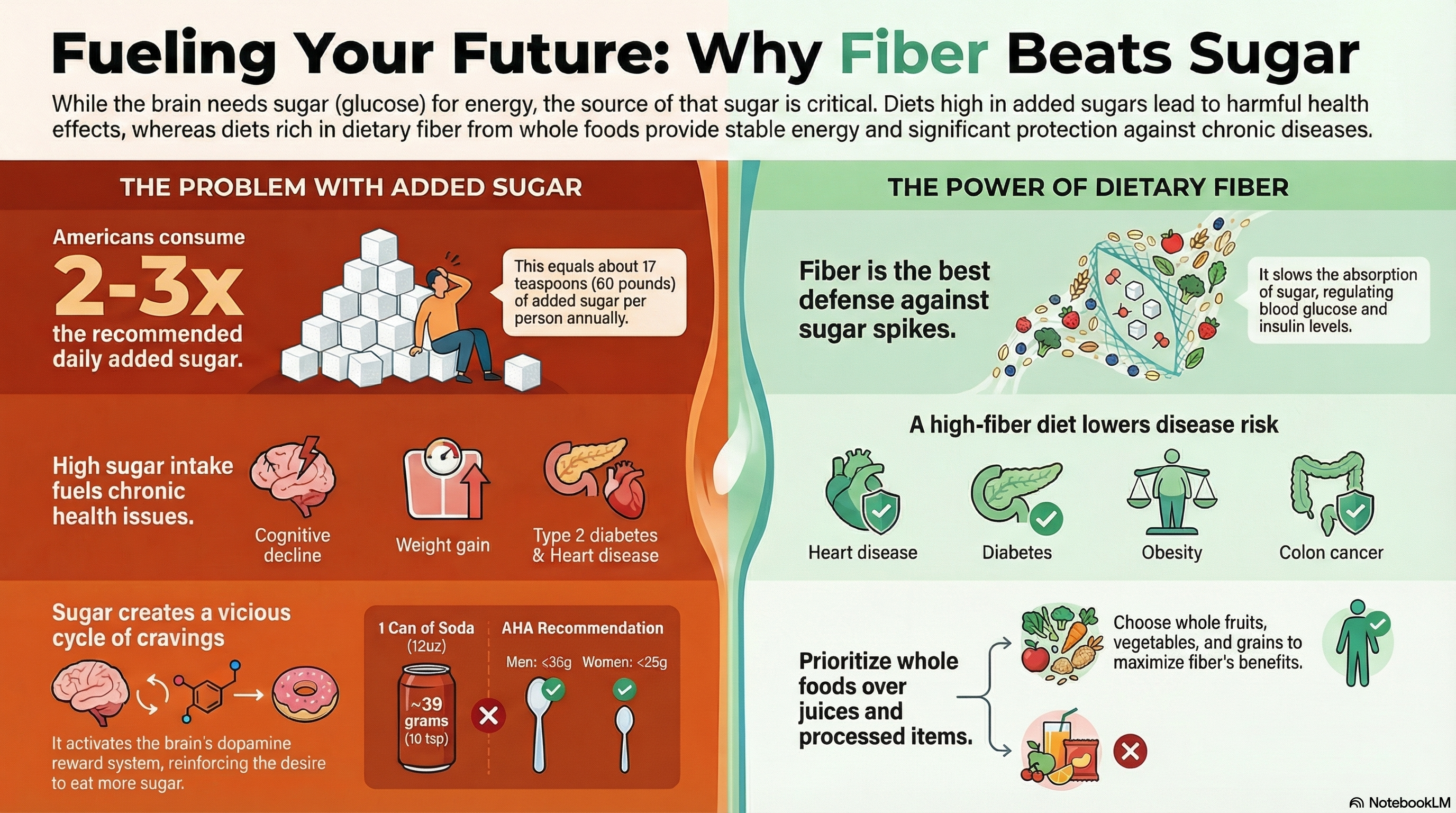
Now think about soda, candy, pastries, or many packaged breakfast foods. These contain added sugars - sugars stripped of fiber and context, designed to absorb quickly. When you eat them, glucose hits your bloodstream fast. Your brain responds with a brief chemical celebration—dopamine and serotonin spike, and for a moment you may feel energized, focused, or soothed. Then comes the drop. Your body scrambles to manage the sugar surge, blood glucose falls quickly, and the brain feels the consequences: fogginess, irritability, restlessness, anxiety, or fatigue. The reward system remembers the brief pleasure, though—and encourages you to repeat the cycle. Over time, a diet heavy in added sugars has been linked to inflammation in the brain and difficulties with learning and emotional regulation. The effects aren’t always dramatic—but they are cumulative. The good news is that there’s a built-in stabilizer that changes the entire equation.
Fiber: The Quiet Stabilizer
Fiber doesn’t get much attention because it doesn’t create a sensation. You don’t feel fiber working. But it may be one of the most important nutrients for your brain. Fiber is a carbohydrate that your body can’t digest. When fiber is present, sugar slows down. Absorption becomes gradual. Blood glucose rises gently instead of spiking. Your brain stays supplied without being overwhelmed. Protein helps with fullness. Fat helps with satisfaction. Fiber is uniquely effective at controlling how sugar affects your brain by reducing the metabolic stress that leads to inflammation and mental fatigue. In practical terms, fiber turns food into long-lasting mental energy.
The 5-to-1 Rule
Nutrition labels can feel overwhelming, so here’s a simple filter that works surprisingly well:
For every 5 grams of sugar, look for at least 1 gram of fiber.
This ratio mirrors how sugar shows up in nature. An apple, for example, has roughly a 5-to-1 sugar-to-fiber ratio. Foods closer to 2-to-1 or even 1-to-1 are even better. This one check can help you spot foods that support steady energy instead of quick spikes.
Connecting brain health to our state
Commercialism creates barriers to understanding the implications of the sugar, body, brain connection. Sugar and confectionary products industry is estimated to spend over $600 million on advertising, while beverage companies spend about $1 billion. These corporate narratives with a busy life can make it difficult to understand how much sugar people consume or how much we should consume. What is the recommended amount of sugar? Spotting Added Sugar The American Heart Association recommends keeping added sugar under:
- 25 grams (6 teaspoons) per day for women
- 36 grams (9 teaspoons) per day for men
For context:
- One 12-ounce soda contains about 42 grams of added sugar
- Many flavored yogurts contain 15–20 grams
Choosing Foods That Fuel Brain Health
Some foods come naturally packaged in a way your brain recognizes and appreciates.
Fruits
- Blueberries support memory and learning through powerful antioxidants.
- Apples offer fiber for steady energy and compounds that protect brain cells.
- Bananas provide gradual glucose and vitamin B6, important for mood-regulating neurotransmitters.
Vegetables
- Leafy greens like spinach and kale are associated with significantly slower cognitive aging.
- Broccoli contains compounds that reduce inflammation and support brain detox pathways.
- Carrots deliver antioxidants that help protect neurons over time.
None of these foods promise instant clarity but do offer reliability.
Nutritional Mindfulness
This isn’t about giving up the things we enjoy. It’s about developing a philosophy of enjoyment with awareness - understanding moderation, noticing how stress shapes our eating habits, and learning to read nutrition labels so we can cut through the noise of commercialized food messaging. Nutritional mindfulness invites us to slow down and reconnect cause and effect: how what we eat influences how we think, feel, and function. It’s not about restriction - it’s about attention. Considerations for finding balance while still enjoying sweetness:
- Savor sweet treats, intentionally and in moderation. Keep portions small, eat slowly, and allow enjoyment to come from presence rather than quantity.
- Notice how you feel after meals. Energy, mood, focus, or fog. Journaling—even briefly—can help reveal patterns that otherwise go unnoticed.
- Begin the day with nourishment in mind. Something as simple as a banana at breakfast can be an intentional act of fueling the brain before the day’s demands begin.
- Track daily weigh-ins with curiosity, not judgment. Daily weigh-ins can help connect nutrition, stress, and weight changes—offering feedback rather than self-criticism.
References
At its core, nutritional mindfulness is about listening—using everyday choices as information. When we pay attention, food stops being just fuel or indulgence and becomes part of a larger conversation with our bodies and minds.
Alahmari, L. A. (2024). Dietary fiber influence on overall health, with an emphasis on CVD, diabetes, obesity, colon cancer, and inflammation. Frontiers in Nutrition, 11, 1510564. https://doi.org/10.3389/fnut.2024.1510564.
American Heart Association. (n.d.). How much sugar is too much?.
Centers for Disease Control and Prevention. (2024, July 16). Your brain and diabetes.
Edwards, S. (2016). Sugar and the brain. On The Brain: The Harvard Mahoney Neuroscience Institute Letter, Spring 2016. Harvard Medical School.
Gillespie, K. M., White, M. J., Kemps, E., Moore, H., Dymond, A., & Bartlett, S. E. (2024). The impact of free and added sugars on cognitive function: A systematic review and meta-analysis. Nutrients, 16(1), 75. https://doi.org/10.3390/nu16010075.
Harvard T.H. Chan School of Public Health. (2025). Fiber. The Nutrition Source.
Murray, S., Tulloch, A., Criscitelli, K., & Avena, N. M. (2016). Recent studies of the effects of sugars on brain systems involved in energy balance and reward: Relevance to low calorie sweeteners. Physiology & Behavior, 164(Pt B), 504–508. https://doi.org/10.1016/j.physbeh.2016.04.004