A Guide to Rhetoric, Power, and Persuasion

On January 29, 2026, amid the echoing tension of a Minneapolis crisis, Border Czar Tom Homan stood before a bank of microphones to perform a masterclass in rhetoric. To the untrained ear, it was a briefing on public safety; to the rhetorical analyst, it was the unveiling of a sophisticated "Rhetorical Architecture." This is the invisible scaffolding of persuasion—the strategic construction of a narrative where specific words, emotional anchors, and logical frames are used to build a "reality" that justifies the Federal government’s abuse of power.
This article is an educational unmasking. We are looking past the podium to see how language is weaponized to manage crisis and public perception. In Homan’s address, we see "mixed messaging" used not as a mistake, but as a rhetorical shield. By centering the word "targeted," Homan cloaks a 3,000-agent federal surge in a moderate veneer, signaling precision to a nervous public while simultaneously whispering to his base that "no one is off the table." To understand this architecture is to see how "the human" is defined, and often erased, by the state.
The Humanization Gap: "Patriots" vs. "Agitators"
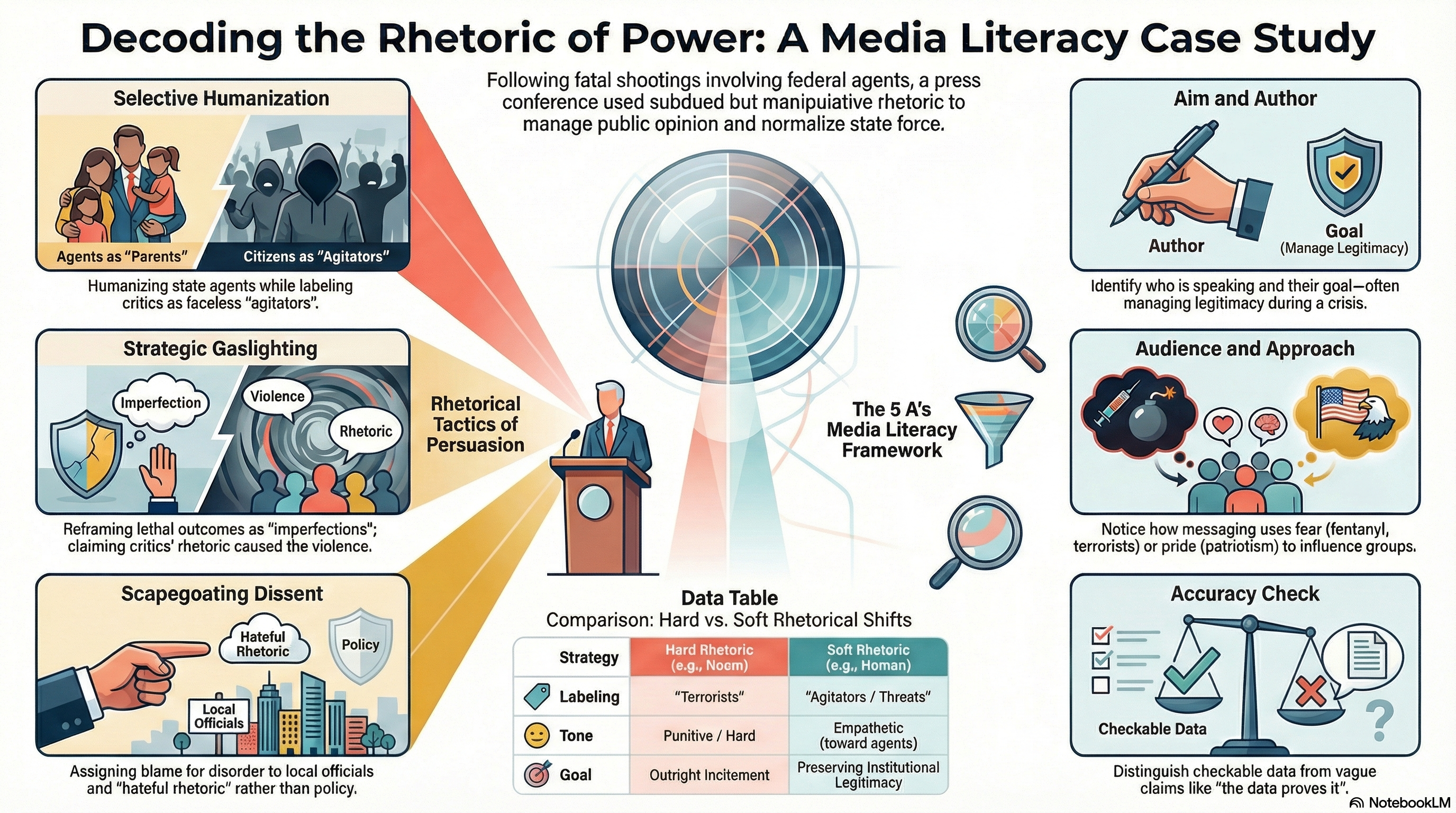
In the theater of political speech, Selective Humanization is a tactical necessity. By granting one group a relatable internal life while reducing another to a flat, threatening label, a speaker can pre-emptively settle moral debates before they even begin. Homan employed this gap with surgical precision, creating a moral hierarchy between federal enforcement and civilian dissenters:
• Federal Agents as "Patriots": Homan paints ICE and CBP officers as "American patriots" and "mothers and fathers" who "don’t hang their hearts on a hook." He anchors this with visceral, high-trauma imagery: agents giving CPR to a baby thrown into a river by cartels or witnessing women raped in the brush.
• Dissenters as "Agitators": In sharp contrast, Homan reduces citizens and protesters to "agitators" fueled by "hateful rhetoric." They are stripped of their roles as parents or neighbors and reframed as faceless sources of "dangerous threats."
The "So What?" Layer: This humanization serves as "moral immunity." By foregrounding the agents' trauma and their status as "sons and daughters," Homan makes it rhetorically impossible to critique the institution’s conduct without appearing insensitive to the agents’ humanity. This is classic prejudice: humanize the aggressor and create an irrational attitude of hostility against observers and peaceful protestors.
Securitization and the Architecture of Blame
To justify extraordinary measures—like the deployment of 3,000 agents into an interior American city—officials rely on Securitization Theory. This is the process of framing a policy issue as an "existential threat" to justify suspending standard rules of deliberation. Homan securitizes the city by identifying "scapegoats" to carry the weight of the crisis.
| Target of Blame | Homan’s Rhetorical Label | The Narrative Function |
| Local Officials | Non-cooperative leaders | Shifts responsibility for the federal surge from the state to the city's "refusal" to comply. |
| Dissenters | "Agitators" / "Hateful Rhetoric" | Frames civil resistance as the cause of violence, rather than a reaction to enforcement. |
| Previous Administration | "Open Border" / "Joe Biden" | Externalizes current failures by blaming a legacy of "unvetted" entries and "humanitarian crisis." |
| Criminal Cartels | Rapists / Fentanyl traffickers | Uses graphic, existential threats to justify the "necessity" of aggressive surges. |
Homan further weaponizes "Causal Inversion," a tactic where the reaction to enforcement is blamed for the violence caused by the enforcement itself. He claimed "hateful rhetoric" caused the bloodshed, despite evidence that the massive federal surge preceded the protests. He also utilized the "Appeal to Invisible Evidence," claiming that "96 percent less people come in" and asserting "the data proves it," while burdening the listener to find said data rather than providing a source.
Gaslighting and "Asymmetrical Doubt"
Political gaslighting is not just lying; it is the practice of creating "Asymmetrical Doubt." This forces the public to question their own eyes regarding state violence while accepting the state’s immediate judgment of the public. Homan’s treatment of evidence illustrates this perfectly:
• State Violence: When pressed on the shooting of Alex Pretti or other federal violence, Homan adopted a stance of bureaucratic caution: "Let the investigation play out," he urged, adding, "No agency is perfect." He even deflected personal responsibility by stating, "Do I have an opinion? Yes. My personal opinion but I’m not going to share that with you."
• Gaslighting Criticism: Conversely, Homan spoke with absolute, prophetic certainty regarding the public. He declared that "hateful rhetoric has caused bloodshed" and lamented, "I wish I wasn't right."
The "So What?" Layer: Asymmetrical Doubt creates a waiting game. The public is told to wait months for "official" findings on a federal shooting, but they must accept Homan’s immediate moral verdict on their own dissent. This destabilizes a shared reality, making state harm an "unknowable glitch" while civilian resistance is a "certain crime."
The Media’s Role: Neutrality vs. Laundering
In the face of such sophisticated rhetoric, "Descriptive Neutrality" in journalism—simply reporting what was said—functions as propaganda support. During the Minneapolis briefing, we saw several "Media Failure Modes" that laundered Homan's messaging into common sense:
1. Adoption of State Language: CNN anchor Sara Sidner called the word "targeted" the "important word" and one of the "big lines," effectively doing Homan's work for him. By centering "targeted," the media anchored a narrative of precision, even as Homan explicitly stated that no undocumented person is "ever off the table."
2. Focus on Performance over Power: Correspondent Priscilla Alvarez described Homan’s performance as his "classic playbook" and noted his "subdued" tone. By focusing on the style of the speaker, the media distracted the audience from the substance of the 3,000-agent surge.
3. Softening Internal Contradictions: Media reports often failed to juxtapose Homan’s claims of "cooperation" with his coercive threat: that the federal "drawdown" depended entirely on local compliance. When journalists act as gatekeepers who prime the audience to accept policy-justifying frames as "neutral facts," they become part of the very architecture they are meant to dismantle.
Conclusion: Developing Civic Resilience
Analyzing the rhetoric of officials like Tom Homan is an essential act of civilian oversight. When we recognize selective humanization, causal inversion, and asymmetrical doubt, we move from being passive consumers to active analysts of our own democracy. To navigate the flood of state communication, we must apply the 5 A’s Framework:
• Aim: What is this message trying to make me think, feel, or do?
• Author: Who is speaking, and what institutional power or "monopoly of knowledge" do they represent?
• Audience: Who is the intended target, and who is being excluded or "othered"?
• Approach: What emotional cues (fear, insecurity, entitlement) are being used to bypass my critical thinking?
• Accuracy: What claims are backed by verifiable data, and what is merely "invisible evidence" or an anecdotal story?
Information literacy is more than detecting a lie; it is about maintaining the capacity to be resilient to demagogic leaders and harmful labels that are designed to divide and dehumanize. By asking better questions of those in power and being mindful of our sources of information, we reclaim our role as the ultimate check on the Rhetorical Architecture of the state.