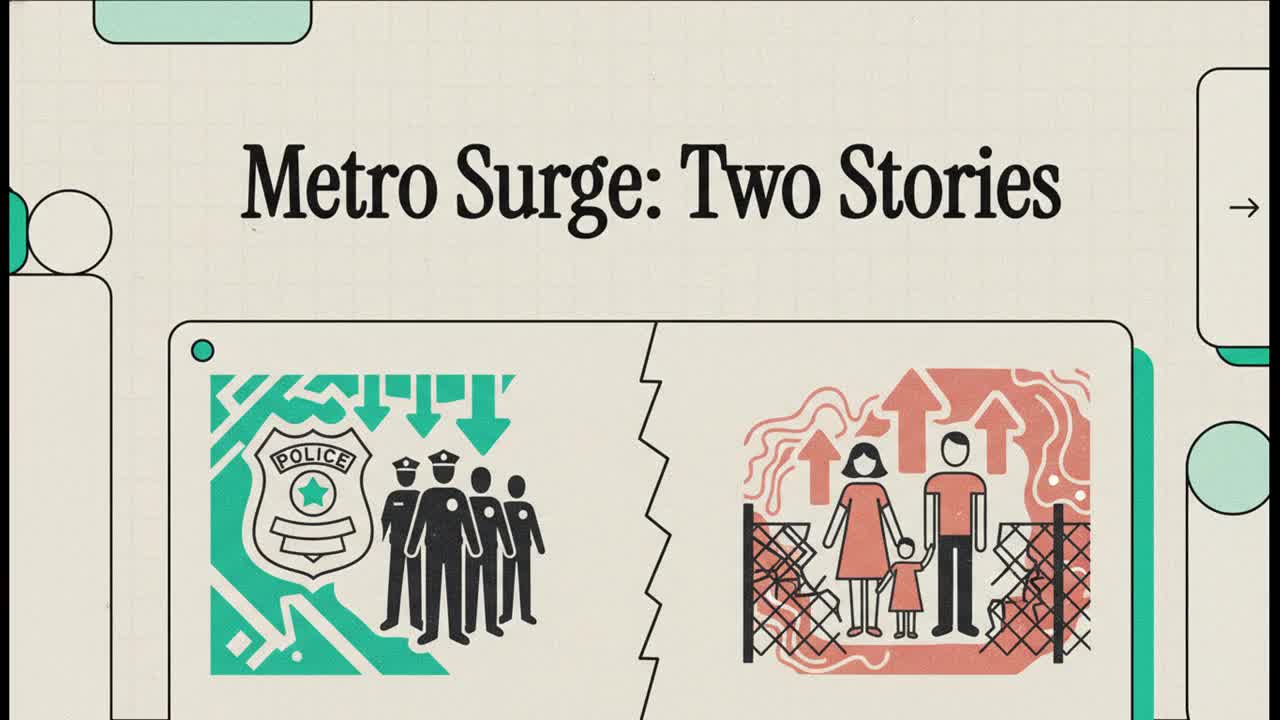
Operation Metro Surge Analysis (1/23/2026)

This document analyzes increased immigration enforcement in Minnesota during the early 2026 Operation Metro Surge, highlighting a significant gap between government rhetoric and documented facts. While federal officials claim to target high-level criminals, data indicates that many detainees are non-criminal individuals, including minors, asylum seekers, and even U.S. citizens. The text details aggressive tactics used against protesters and the "inhumane" conditions found in detention facilities. It also identifies specific legal resources for affected families and lists the various Minnesota counties that formally cooperate with federal agents. Furthermore, the report addresses the existence of arrest quotas and clarifies that state prisons have historically cooperated with federal transfers despite political claims to the contrary. Ultimately, the sources serve to counteract government propaganda by providing a comprehensive overview of the legal and humanitarian crisis unfolding in the region.
Fact-Checking the "Metro Surge": A Media Literacy Guide to Immigration Enforcement
The Power of Critical Verification
In an era of rapid-fire news and polarized political rhetoric, the ability to bridge the gap between high-level government narratives and grounded operational data is a cornerstone of informed citizenship. This handout is designed to empower learners to navigate the complexities of Operation Metro Surge, a large-scale immigration enforcement initiative launched in late 2025.
By analyzing the discrepancies between "high-level" public statements and the reality documented in legal filings, we can better understand how federal policy impacts our local communities. Verifying these claims is essential for maintaining a transparent democracy and protecting the civil rights of all residents.
When government narratives go unverified, the stakes extend beyond simple misinformation. Inaccurate reporting on public safety can obscure systemic civil rights violations, mislead the public on the effectiveness of law enforcement, and hide the human costs of enforcement. Verification ensures that public discourse remains rooted in evidence rather than manufactured atmospheric claims.
To begin this process, we must look at the primary narrative used to justify the surge: the criminal history of those being detained.
Claim vs. Reality: The "Criminal History" Narrative
The official narrative characterizes detainees as the "worst of the worst"—dangerous threats to public safety. However, verified data reveals that Operation Metro Surge casts a significantly wider and less precise net than the rhetoric suggests.
Narrative vs. Data: Criminality in Operation Metro Surge
| Official Claim | Verified Fact |
|---|---|
| "3,000 vicious criminals arrested" in Minnesota since December 2025. | DHS released only ~240 names (as of Jan 19) to support the 3,000-arrest claim. |
| 70% of detainees have significant criminal histories. | Nationally, 73.6% of ICE detainees have no criminal record as of late 2025. |
| Arrests focus solely on "murderers and rapists." | Many featured individuals were low-level offenders (traffic tickets/DWIs) or were already in federal custody. |
The "So What?" of the Narrative When the administration displays photos of "criminals," critical readers must look at the individual context. Investigations show that roughly 70 of the individuals on the "worst of the worst" list were never in Minnesota state custody; they were federal prisoners serving time in facilities located in Minnesota with no other connection to the state.
Furthermore, the surge involves significant human collateral. In January 2026, agents detained 5-year-old Liam Conejo Ramos, using the child as "bait" to draw his father out of their home. This highlights a shift from targeted enforcement to high-impact psychological tactics involving minors and families with active, legal asylum cases. While the narrative focuses on who is being arrested, it often intentionally omits how these individuals are already managed by state systems.
Debunking the "Non-Cooperation" Myth
A recurring claim is that Minnesota officials refuse to "turn over" criminals, creating a "sanctuary" for violence. Evidence from the Minnesota Department of Corrections (DOC) reveals a high level of existing cooperation.
The Three Pillars of Existing Cooperation:
1. Direct Transfers: In 2025, the Minnesota DOC directly transferred 84 individuals from state prisons to ICE custody immediately upon the completion of their sentences.
2. Honoring Detainers: DOC Commissioner Paul Schnell confirmed that state policy honors ICE detainers, directly contradicting claims of a total refusal to cooperate.
3. Past Handoffs: Many "new" arrests showcased in 2026 briefings involved individuals the state had already handed over to ICE months prior (between August and November 2025), long before the "surge" began.
This reality shifts the focus from a lack of state cooperation to the administrative pressures driving federal enforcement actions.
The Mathematics of Enforcement: Arrest Quotas & Metrics
Evidence suggests a shift in federal strategy from prioritizing public safety threats to meeting strict numerical targets. This "quota-driven" environment fundamentally changes ground-level operations.
Consequences of Quota-Driven Enforcement:
• Decreased Quality of Arrests: Under pressure to meet a national goal of 3,000 arrests per day, the "quality" of arrests has plummeted. Arrests of individuals with no criminal record surged by over 2,400% in late 2025.
• Collateral Damage: Agents increasingly utilize "collateral arrests," detaining everyone present at a location (like an apartment building or workplace) regardless of whether they were the target. This includes the detention of four students from Columbia Heights in a single two-week span.
• Roving Patrols: The drive for numbers has led to "fishing" operations and "suspicionless stops," such as the Minneapolis stop of 20-year-old U.S. citizen Mubashir Khalif Hussen by masked agents.
"There is a number... it’s called all of them." — Commander Greg Bovino, Border Patrol (responding to questions regarding arrest quotas in the Twin Cities, January 22, 2026).
These administrative metrics frequently clash with the legal protections afforded to residents and observers.
Civil Liberties and the "Legal War"
Operation Metro Surge has sparked a "legal war" between federal authority and state protections, specifically regarding the treatment of protesters and the use of "administrative warrants."
| Government Assertion of Authority | Judicial/State Pushback |
|---|---|
| Warrantless Home Entries: ICE uses "administrative warrants" (not signed by a judge) to enter private residences. | Attorney General Opinion: AG Keith Ellison stated Sheriffs cannot unilaterally sign 287(g) agreements; however, many Sheriffs are ignoring this, claiming "autonomy." |
| Use of Force: Agents have used tear gas, pepper spray, and rubber bullets against protesters and legal observers. | Judicial Injunction & Stay: Judge Menendez barred the use of chemical irritants on Jan 16, but the 8th Circuit Court of Appeals stayed this injunction on Jan 21, 2026, restoring ICE's ability to use these tactics. |
| 287(g) Agreements: Counties like Sherburne, Freeborn, and Crow Wing act as federal hubs, holding detainees or assisting in street-level operations. | Constitutional Challenges: Civil rights groups are challenging local cooperation as a violation of the Minnesota Constitution. |
The shifting legal landscape, particularly the recent 8th Circuit stay, necessitates that community members and observers remain highly informed of their current (and precarious) protections.
Critical Thinking Questions for Immigration Reports
1. Does the number of names released match the total arrest claim? Look for the discrepancy between the "thousands" claimed and the small fraction of names actually provided.
2. What is the specific nature of the "criminal history"? Determine if the record consists of violent felonies or low-level misdemeanors like traffic tickets or DWIs.
3. Have I searched for name variations? Be aware that ICE often misspells names or reverses first and last names in their databases. If a search fails, switch the name order to verify the record.
Maintaining a transparent democracy requires citizens to demand evidence that matches the rhetoric. By using data-driven evidence, you can look past the headlines to see the true operational reality.
Applied Media Literacy: A Resource & Verification Toolkit
To be an effective observer, you must know where to find grounded information and how to interpret it.
Verification and Support Resources
| Information Needed | Verified Resource/Tool |
|---|---|
| Locate a detained individual | ICE Online Detainee Locator (Search by A-Number or full biographical data). |
| Report agent misconduct | ACLU of Minnesota Hotline: (651) 645-4097 |
| Legal representation | Immigrant Law Center of MN (ILCM): (651) 641-1011 <br> Hours: Mon 2-4 PM; Thu 10-12 PM. |
| Real-time raid reporting | Monarca Hotline: (612) 441-2881 |
| Asylum/Detention help | The Advocates for Human Rights: (612) 341-9845 |