Executive Corruption and Democratic Erosion Rankings

How Asking an AI Differently Changes What We Learn
One of the most overlooked skills in using artificial intelligence for self-education isn’t technical—it’s learning to ask better questions. This became clear in a recent experiment designed to uncover the hidden assumptions in how we discuss political malfeasance. When I prompted an AI to rank the “most corrupt U.S. presidents,” it produced a list defined by indictments, financial misconduct, and personal enrichment. But a different question—which presidents “posed the greatest risk to democracy”—yielded a significantly different roster. Some names appeared on both lists, but the shifts and omissions revealed a crucial distinction. That difference is the lesson. By exploring the contrast between these two answers, we can see how the very framing of a question shapes what we learn, revealing that the gravest threats to a nation’s foundations are not always tied to a lust for wealth, but to a lust for power.
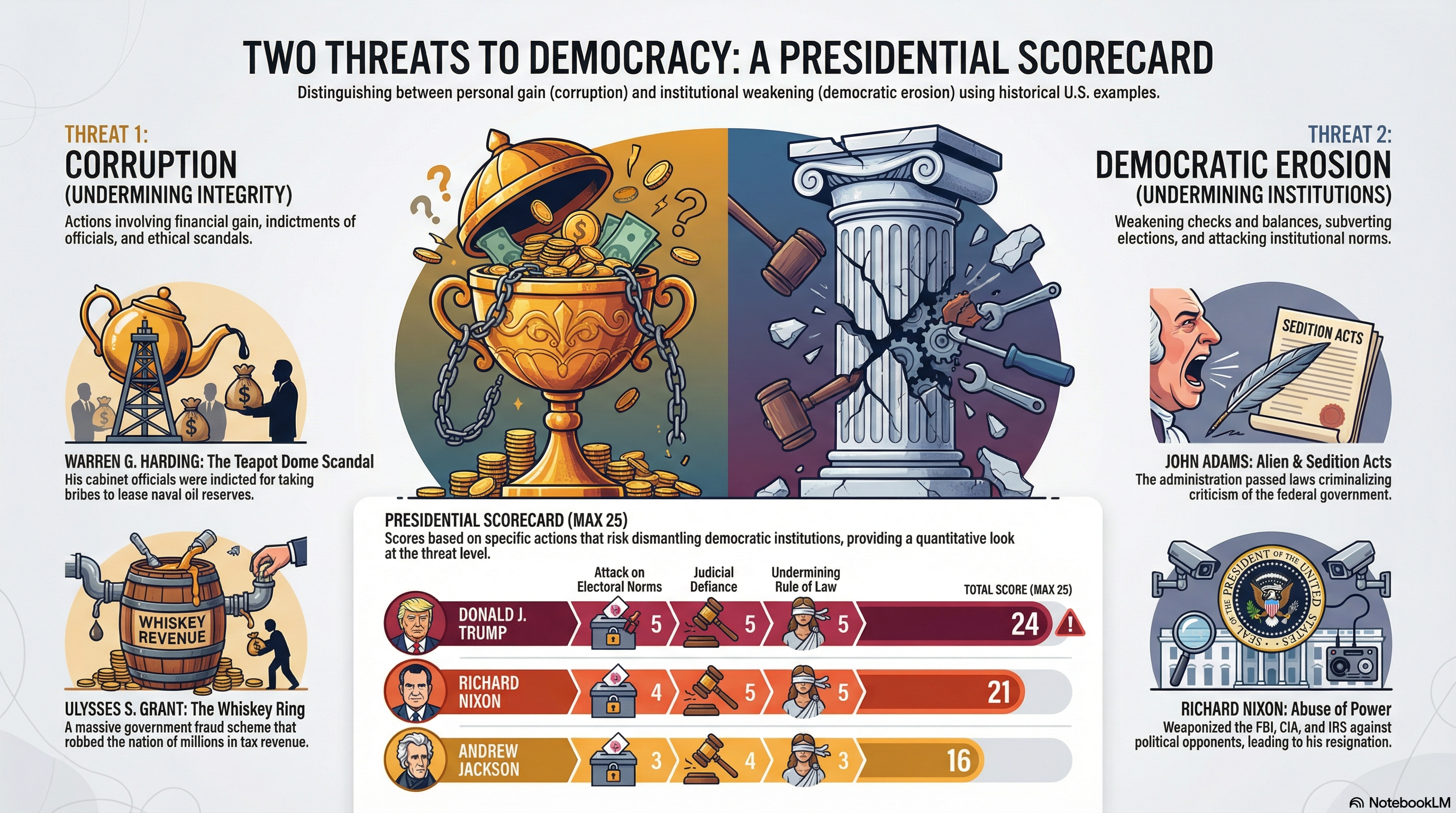
1. Corruption and Democratic Erosion Are Not the Same Thing
The experiment reveals a critical distinction: while financial corruption and democratic erosion can be related, they are fundamentally different threats. Corruption, as defined in the first query, is measured by graft, scandal, and ethical violations for personal or political gain. While the administrations of Warren G. Harding—whose legacy is dominated by the Teapot Dome scandal involving the illegal leasing of naval oil reserves for bribes—and Ulysses S. Grant typified this old-guard corruption, they did not appear on the list of presidents who posed the greatest risk to democracy. Their misconduct was transactional, a pursuit of wealth and influence.Democratic erosion, in contrast, is an ideological threat defined by the abuse of power, attacks on institutional checks, and the defiance of constitutional constraints. The threat posed by John Adams, for instance, was not a scheme for financial enrichment. It was an assault on the principle of dissent itself, using the Alien and Sedition Acts to criminalize criticism of the government, specifically targeting opposition newspapers—a direct attack on a core democratic freedom.
2. Some Presidents Threaten Democracy Without Being Financially Corrupt
The analysis also unearths a more subtle threat—presidents who undermine democracy not for personal enrichment, but in the name of national security or state power. President Woodrow Wilson is rarely mentioned in discussions of corruption, yet his administration oversaw some of the “harshest civil-liberties restrictions in U.S. history.” During World War I, the Espionage Act of 1917 and the Sedition Act of 1918 criminalized dissent and anti-war speech, leading to thousands of political arrests. This represents a clear case of an administration prioritizing state power over fundamental democratic freedoms during a time of crisis, demonstrating that a president can pose a profound risk to the constitutional order without a single dollar changing hands improperly.
3. Others Mastered Both
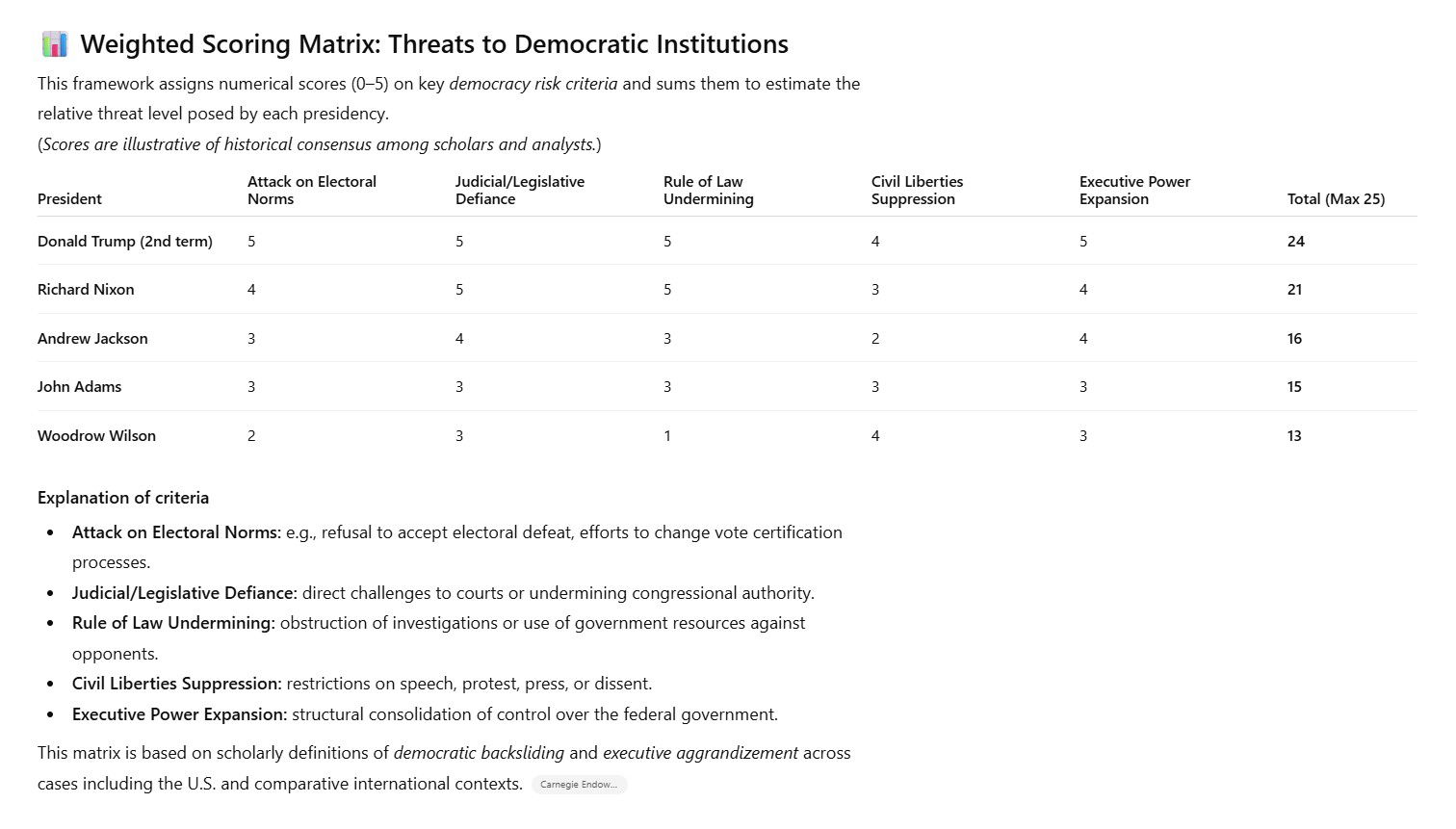
While some presidents exemplify one threat or the other, the nation’s most infamous presidencies are those that mastered both, representing a dual assault on American governance. Richard Nixon’s Watergate scandal is the textbook case of this dual threat. The financial corruption—illegal campaign financing and secret slush funds—created the motive for the subsequent abuse of power. The cover-up metastasized into a constitutional crisis involving criminal break-ins, systematic obstruction of justice, and the misuse of the CIA, FBI, and IRS against political opponents, showing how one form of misconduct can fuel the other. The administration of Donald J. Trump also fell into both categories. On the corruption front, it was marked by the extensive use of Trump-owned properties for government business and unprecedented Emoluments Clause lawsuits. In terms of democratic erosion, his record includes two impeachments—the first for abuse of power and obstruction of Congress (Ukraine) and the second for incitement of insurrection (Jan. 6)—alongside attempts to overturn the 2020 election and repeated efforts to delegitimize the media, courts, and the electoral process itself.
4. The Nature of the Threat Evolves Over Time
The methods used to undermine democratic norms have morphed over time, reflecting the political realities of each era. The threat began with Andrew Jackson’s “majoritarian populism,” which undermined institutional checks when he defied a Supreme Court ruling on Indian Removal and expanded the “spoils system” to replace civil servants with political loyalists. The threat evolved with Richard Nixon, whose presidency set the modern benchmark for weaponizing the state’s internal machinery—intelligence and law enforcement agencies—against democracy itself. This has now morphed into what political scientists call “executive aggrandizement,” a model visible in the actions of Donald J. Trump. This occurs when a leader expands his power beyond the “checks and balances” provided by the legislature and the judicial system or interferes with the independence of the civil service to serve partisan ends.This modern form of democratic decay can be deceptively subtle, unfolding behind a façade of normalcy."The electoral road to breakdown is dangerously deceptive… People still vote. Elected autocrats maintain a veneer of democracy while eviscerating its substance."
5. What's the Next Question?
Ultimately, the AI is a mirror. The answers it provides are less a reflection of its own intelligence and more a precise reflection of the blind spots, assumptions, and limitations embedded in our own questions. True learning begins when we start critiquing the question, not just consuming the answer.The distinction between corruption and democratic erosion is just one example. What other critical distinctions are we failing to see because we aren't asking the right questions?
References
Associated Press. (2025, March 1). Trump’s moves test the limits of presidential power and the resilience of US democracy. AP News. https://apnews.com/article/542ac437a58880e81c052f8f2df1643f
Associated Press. (2025, May 4). America’s long history of ‘checks and balances’ is being tested by Trump like rarely before. AP News. https://apnews.com/article/979b5d303442cfa90fb0771fa177cb95
Carrier, M., & Carothers, T. (2025, August 25). U.S. democratic backsliding in comparative perspective. Carnegie Endowment for International Peace. https://www.carnegieendowment.org/research/2025/08/us-democratic-backsliding-in-comparative-perspective
Roos, D. (2025, February 17). The Sedition and Espionage Acts were designed to quash dissent during WWI. HISTORY. https://www.history.com/articles/sedition-espionage-acts-woodrow-wilson-wwi
Schlesinger, A. M., Jr. (1973). The imperial presidency. Houghton Mifflin.
Nelson, D. D. (2008). Bad for democracy: How the presidency undermines the power of the people. University of Minnesota Press.
U.S. House of Representatives. (1798). The Sedition Act of 1798. https://history.house.gov/Historical-Highlights/1700s/The-Sedition-Act-of-1798/
U.S. National Archives. (1798). Alien and Sedition Acts. https://www.archives.gov/milestone-documents/alien-and-sedition-acts
Washington Post. (2025, June 21). Trump undermines Watergate laws in massive shift of ethics system. https://www.washingtonpost.com/politics/2025/06/21/trump-watergate-presidency-congress/
Williamson, V. (2023, October 17). Understanding democratic decline in the United States. Brookings Institution. https://www.brookings.edu/articles/understanding-democratic-decline-in-the-united-states/
Williamson, V. (2023, October 30). Democratic erosion: The role of executive aggrandizement. Brookings Institution. https://www.brookings.edu/articles/democratic-erosion-the-role-of-executive-aggrandizement/
Wikipedia contributors. (2025). Alien and Sedition Acts. In Wikipedia, The Free Encyclopedia. https://en.wikipedia.org/wiki/Alien_and_Sedition_Acts Nixon Foundation. (n.d.). Watergate explained. https://www.nixonfoundation.org/watergate-explained/